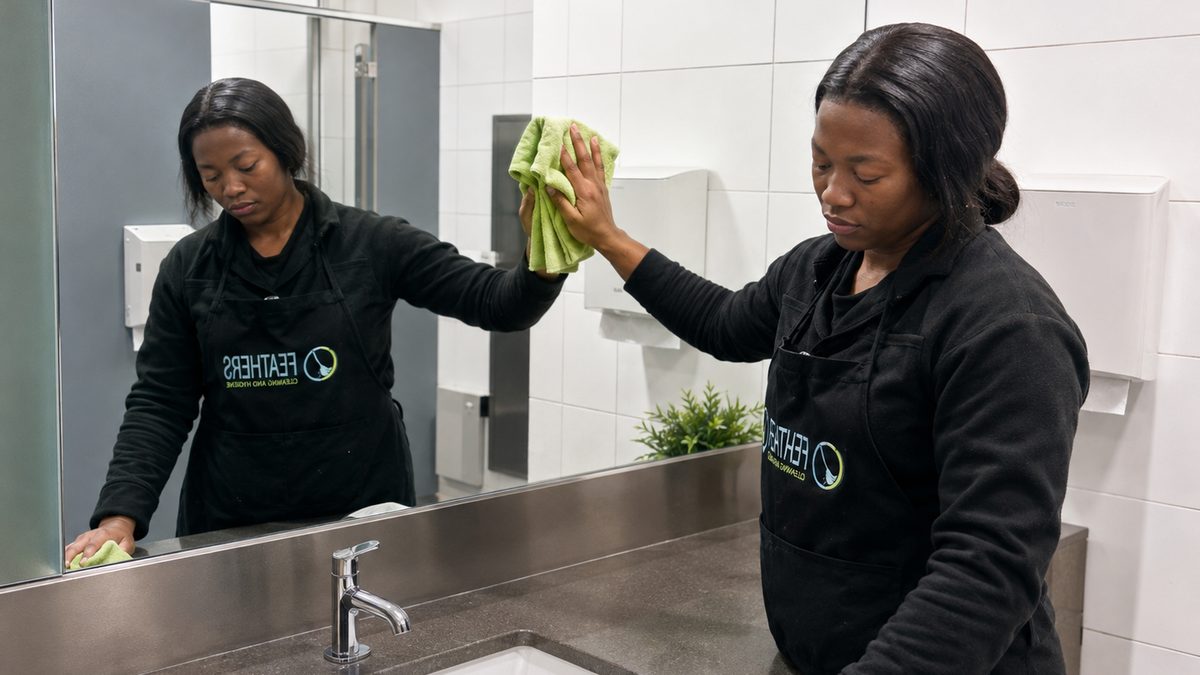
A practical standard you can hold a contractor to.
Restrooms are the most consequential ten square metres in any workplace. They are the single most-cited factor in how staff and visitors judge an employer's standards, they carry the clearest legal obligations of any area on site, and they are the one place where a lapse is noticed immediately by everyone.
They are also, in most businesses, cleaned to a routine nobody has ever actually written down. This is a practical standard you can hold a contractor or an internal team to.
Why Restrooms Carry Disproportionate Weight
Legal obligation. South African employers carry duties around the provision and maintenance of sanitary facilities under occupational health and safety legislation. The specifics vary by workplace type and headcount, and the correct source is the applicable regulations and your own compliance advisor — but the general position is unambiguous: maintaining ablution facilities in a clean, working, adequately stocked condition is an employer duty, not a courtesy.
Hygiene. Restrooms concentrate the highest-transmission surfaces in any building, and the inside door handle is the last thing touched before someone returns to shared space.
Perception. Staff read restroom condition as a direct statement about how the employer regards them. Visitors read it as a sample of operational standards. Neither reading is unfair.
The Correct Order of Work
Sequence matters more in restrooms than anywhere else, because working out of order redistributes contamination rather than removing it. The correct order:
- Ventilate and set signage. Open extraction, place wet floor and closure signage.
- Remove waste. General and sanitary bins, replace liners.
- Apply chemical and leave it to dwell. Toilet bowls, urinals and any descaling application go on first so they work while you do everything else. This is the single biggest efficiency in restroom cleaning and the most commonly skipped step.
- Clean high to low. Vents, tops of cubicles, mirrors, dispensers, then walls and partitions.
- Basins and taps.
- Return to toilets and urinals — the chemical has now had its contact time. Clean, then disinfect.
- High-touch points disinfected with observed dwell time.
- Restock all consumables.
- Floors last, working out of the room.
- Final check and remove signage once dry.
Dwell time is the whole game
Disinfectants and descalers require the surface to stay wet with product for a stated contact time. Spraying a toilet and immediately wiping it dry cleans it; it does not disinfect it, and the product is wasted. Applying chemical at step three and returning at step six builds the required dwell into the workflow instead of relying on someone standing and waiting. If a cleaning team cannot tell you the dwell time of the product they are using, they are not disinfecting — they are wiping.
The Daily Standard
Toilets and urinals
- Bowl cleaned including under the rim and the waterline
- Seat cleaned and disinfected — both faces, plus the hinges
- Cistern, flush handle or button, and the pipework behind
- Exterior of the pan, including the base and the floor junction, which is where odour originates
- Urinal bowl, spreader and any strainer or screen
- Cubicle door, lock, handle and coat hook
Basins and vanity
- Basin bowl, overflow and plughole
- Tap body and handles — including underneath the spout
- Vanity surface and edges
- Underside of the basin and exposed pipework
- Mirror, streak-free, including the frame and lower edge
High-touch points
- Inside door handle — the highest-priority item in the room
- Outside door handle and push plate
- Cubicle locks and door edges
- Tap handles
- Soap dispenser pump or button
- Paper towel dispenser handle and hand dryer button
- Light switch
- Sanitary bin lid or pedal
- Baby change unit where fitted
Floors, waste and stock
- Floor swept and mopped including behind the door, around pan bases and in corners
- Skirtings and floor-wall junction
- All bins emptied, liners replaced, bin bodies wiped
- Sanitary waste handled under the correct disposal arrangement
- Soap, paper towel, toilet tissue and hand sanitiser restocked to full
Weekly and Periodic Work
Weekly
- Descaling of taps, spouts, urinals and toilet waterlines
- Cubicle partitions — full surfaces including tops, undersides and fixings
- Tiled walls, not just the splash zone
- Extraction fan grille
- Behind and beneath sanitaryware and pipework
- Dispenser interiors
Monthly to quarterly
- Grout deep clean and sealant condition assessment
- Drain and trap treatment
- Ceiling, vents and light fittings
- Cistern interior inspection where accessible
- Full descale of all sanitaryware
- Review of sealant around basins, pans and shower trays for degradation
Colour Coding and Cross-Contamination
Restroom cloths and mops must never be used anywhere else, and within the restroom itself the toilet and basin areas should be separated.
Standard practice uses colour-coded microfibre and mop systems — commonly red for sanitary areas, blue for general surfaces, green for food preparation and yellow for basins and infection-control areas, though conventions vary. What matters is not which colours you use but that the system is defined, understood and physically prevents a cloth moving from a toilet to a kitchen.
Any contractor who cannot explain their colour-coding system on the spot is telling you something important about their training.
Mould and Moisture Control
Restrooms combine water, warmth and poor airflow. In Gqeberha, coastal humidity adds to the load, and mould establishes faster here than in drier inland locations.
The controls that actually work:
- Extraction that runs long enough. A fan on a light switch stops when the light goes off, which is usually too soon. A run-on timer or humidity sensor is a genuine fix.
- Dry surfaces after cleaning. Leaving basins, shelves and floors wet feeds the problem you are trying to prevent.
- Maintain sealant. Degraded silicone around basins, pans and trays lets water behind the fitting, where mould grows out of sight and eventually causes structural damage.
- Address grout early. Discoloured grout is easier to recover than grout that has been colonised for a year.
- Check ceilings and behind cisterns — mould appears here before anywhere obvious.
Setting Frequency by Traffic
Frequency should be driven by usage, not by a default. A rough framework:
| Setting | Full Clean | Check and Restock |
|---|---|---|
| Small office, low headcount | Once daily | Once daily |
| Standard office | Once daily | Midday check |
| High-density office or shift operation | Twice daily | Two to three checks |
| Industrial site with shift changes | Per shift | Between shifts |
| Public-facing or retail | Two to three times daily | Hourly during peak |
The check-and-restock visit is the highest-return item on this table and the one most often omitted. A restroom that is spotless at seven in the morning and out of paper by eleven is failing, and the fix is fifteen minutes rather than a second full clean.
Consumables: Getting the Boring Part Right
Running out is the most common restroom complaint in any workplace, and it is entirely a systems problem.
- Size dispensers to the traffic. A dispenser that needs refilling twice a day is the wrong dispenser.
- Restock to full, not to adequate. Topping up guarantees a mid-shift failure.
- Hold buffer stock on site and define who monitors it.
- Sanitary disposal needs a proper service arrangement with defined collection frequency.
- Clarify in the contract whether consumables are included or billed separately. This is one of the most common sources of dispute.
A Reporting Route That Works
Most restroom problems are known to staff long before they are known to management. Close that gap:
- Provide an obvious way to report — a notice with a number or email, or a QR code in the cubicle
- Log a cleaning record in the restroom itself, visible and signed
- Act on reports visibly, because a report that produces no response ends future reporting
- Include restrooms in any premises walkaround rather than assuming
The Bottom Line
Workplace restrooms carry the clearest legal obligation, the highest transmission risk and the greatest perceptual weight of any area on site — and they are usually cleaned to an unwritten routine.
The four things that make the most difference: work in the correct order so chemical dwell time is built into the workflow rather than skipped, prioritise the inside door handle and other high-touch points, add a midday check-and-restock rather than a second full clean, and control moisture properly so mould never establishes.
Feathers Cleaning and Hygiene provides washroom and hygiene services across Gqeberha, East London, Mthatha and the wider Eastern Cape.
Want this handled properly?
Tell us what you need cleaned and we will come and look at it before quoting anything.
Request a Written Scope Or call 079 096 3267