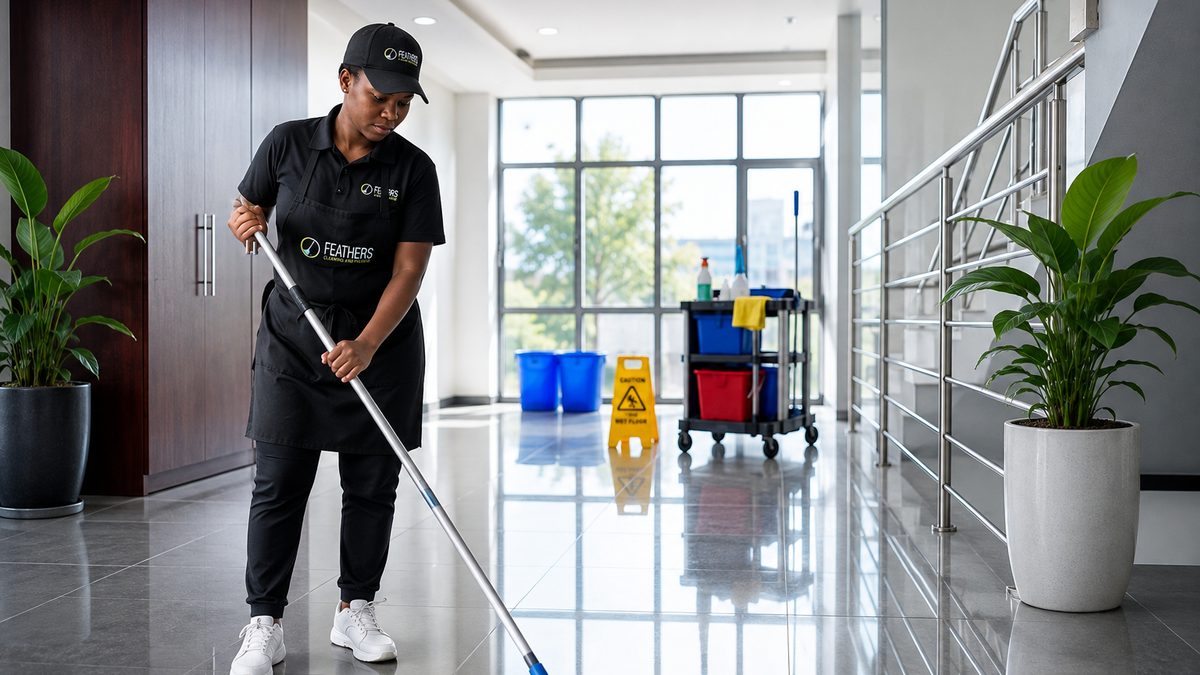
Coastal humidity, salt air and industrial dust give Gqeberha offices a genuinely different maintenance requirement.
Most advice about office cleaning is written as though every office in the world sits in the same climate, breathes the same air and faces the same pressures. Offices in Gqeberha do not. A building three kilometres from the coast in a high-deposition wind corridor has a fundamentally different cleaning requirement to an inland office park — and treating them the same is why so many businesses conclude that their cleaning "just never seems to hold."
Here are five reasons specific to Port Elizabeth and the wider Nelson Mandela Bay area that make professional office cleaning services a practical operational decision rather than a discretionary spend.
1. Industrial Dust Deposition Is a Local Reality, Not a Cleaning Failure
Gqeberha's role as a bulk export point means airborne industrial particulate — manganese dust in particular — is a persistent factor for properties across parts of the metro. It is fine, it travels on the wind, and it finds its way indoors through window seals, door gaps and air-conditioning intakes.
What makes it an office problem specifically:
- HVAC filters load faster than the manufacturer's generic service interval assumes, which means systems work harder and cost more to run
- IT equipment and server rooms accumulate conductive particulate in cooling fins and fan housings
- Reception glazing and entrance doors show it first and most visibly — exactly where clients form their first impression
- Dry wiping makes it worse, grinding abrasive particles into glass and gloss finishes and re-suspending the rest into the air
In-house cleaning staff following a general-purpose routine will almost always underestimate this. The frequency is wrong, the method is wrong, and the result is a building that never quite looks maintained. Professional cleaning that accounts for local deposition is not doing more work — it is doing the correct work, in the correct order.
We cover this in depth in our guide to manganese dust in Port Elizabeth and what actually removes it.
2. Coastal Humidity and Salt Air Change What "Clean" Requires
Nelson Mandela Bay's coastal position brings sustained humidity and salt-laden air. For an office building, that has direct maintenance consequences that a standard cleaning specification tends to ignore.
Mould and moisture
Humidity supports mould growth in exactly the places that get inspected least: behind storage units, in ceiling voids, around air-conditioning drip trays, in kitchenette and bathroom corners, and beneath sinks. Mould in an office environment is not only a building fabric issue — it is an indoor air quality issue and, depending on severity, an occupational health one.
Corrosion on metal fixtures
Salt air accelerates corrosion on security gates, burglar bars, window frames, door furniture, air-conditioning housings and external signage. Regular correct cleaning materially slows this. Neglect brings forward replacement costs.
Glazing and window maintenance
Salt film combined with airborne dust produces a haze on glazing that ordinary interior window cleaning does not resolve. Buildings with large glass frontages in Gqeberha need a schedule that treats external glazing as a recurring item, not an annual one.
The practical point
Humidity and salt do not just make an office look less clean — they actively shorten the service life of building components. Correct, consistent cleaning is a maintenance function, not a cosmetic one.
3. First Impressions Carry More Weight in a Relationship-Driven Market
Business in the Eastern Cape runs substantially on relationships, referrals and reputation. Clients visit premises. Suppliers visit premises. Prospective employees visit premises. In a market this connected, the condition of your reception is not a minor detail — it is a signal about how you run everything else.
The areas that carry disproportionate weight:
- Entrance glazing and door furniture — assessed within seconds of arrival
- Reception flooring — scuffing, tracked-in dust and dull finish read as neglect
- Seating and waiting areas — fabric marks and dust on side tables are noticed
- Bathrooms — the single most-cited factor in visitor perception of a business's standards
- Air quality and odour — registered immediately, even when not consciously articulated
None of these require an expensive refurbishment. They require consistent, competent cleaning to a defined standard. That distinction matters: a well-maintained older building consistently outperforms a neglected new one in visitor perception.
4. In-House Cleaning Costs More Than Most Businesses Calculate
Businesses frequently keep cleaning in-house on the assumption that it is cheaper. The comparison usually leaves out most of the actual cost.
| Cost Factor | In-House | Professional Contractor |
|---|---|---|
| Wages and statutory contributions | Your responsibility | Contractor's responsibility |
| Leave, sick leave and absence cover | You absorb the gap | Contractor provides cover |
| Equipment purchase and maintenance | Capital and repair cost | Included |
| Consumables and chemical supply | Ongoing procurement | Included or managed |
| Training and method competence | Your cost and risk | Contractor's obligation |
| Supervision and quality control | Management time | Contractor's supervisor |
| Recruitment and turnover | Recurring cost | Contractor absorbs |
| Public liability and insurance | Your exposure | Contractor insured |
The line item that gets missed most often is management time. Supervising cleaning staff, sourcing consumables, handling absence and dealing with quality complaints consumes hours from someone whose time is worth considerably more than the cleaning itself. That cost is real; it is simply invisible because it never appears on an invoice.
The second missed cost is method competence. Untrained cleaning does not just underperform — it damages. Wrong chemical on the wrong substrate, dry-wiping abrasive dust across glazing, or over-wetting a timber or laminate floor all produce costs that surface months later as replacement or refinishing.
5. Compliance, Health and Documentation Are Getting Harder to Ignore
Workplace health and hygiene expectations in South Africa have tightened considerably, and the burden of demonstrating compliance sits with the employer. For office environments in Gqeberha, the practical implications include:
- Occupational health and safety obligations around workplace hygiene, ablution facilities and safe access
- Documented cleaning schedules that can be produced when required, rather than reconstructed after the fact
- Correct chemical handling and storage, including safety data sheets and appropriate labelling
- Waste handling that meets municipal requirements
- Contractor compliance — COIDA registration, UIF, valid insurance and tax compliance
A professional contractor should be able to produce documentation on request. An informal in-house arrangement typically cannot, and that gap only becomes visible at the exact moment it matters — during an inspection, an incident investigation, or an insurance claim.
What to ask any cleaning contractor in Gqeberha
Before appointing anyone, ask for: proof of COIDA registration, UIF compliance, a valid tax clearance, public liability insurance details, a written scope of work with defined frequencies, and the name of the supervisor who will actually attend your site. A contractor who cannot produce these quickly is transferring risk to you.
What Good Looks Like for a Gqeberha Office
A cleaning specification appropriate to this market should include, at minimum:
Daily
- Reception, entrance glazing and high-traffic flooring
- Bathrooms — full clean, disinfection and restocking
- Kitchenette and break areas
- Waste removal
- High-touch point disinfection: door handles, light switches, lift buttons, shared equipment
Weekly
- Full desk and workstation detail
- Internal glazing and partitions
- Skirtings, vents and low-level detail
- Under-desk and behind-furniture flooring
Monthly to Quarterly
- External glazing (more frequently in high-deposition or coastal-facing positions)
- High-level dusting: light fittings, ceiling vents, upper racking
- Carpet and upholstery deep clean
- Hard floor treatment — strip, seal or polish as appropriate to the substrate
Annually
- Full deep clean including ceiling voids and inaccessible areas
- Review and reset of the specification against observed conditions
The Bottom Line
Offices in Port Elizabeth are not cleaning the same building as offices elsewhere. Industrial dust deposition, coastal humidity and salt air create a genuinely different maintenance requirement — and a cleaning specification that ignores those factors will underperform no matter how diligently it is followed.
Add the true cost of in-house cleaning, the weight that premises carry in a relationship-driven market, and tightening compliance expectations, and professional cleaning stops being a discretionary line item and becomes a straightforward operational decision.
Feathers Cleaning and Hygiene works across Gqeberha, East London, Mthatha and the wider Eastern Cape, building office cleaning schedules around what each building is actually exposed to.
Want this handled properly?
Tell us what you need cleaned and we will come and look at it before quoting anything.
Request a Written Scope Or call 079 096 3267