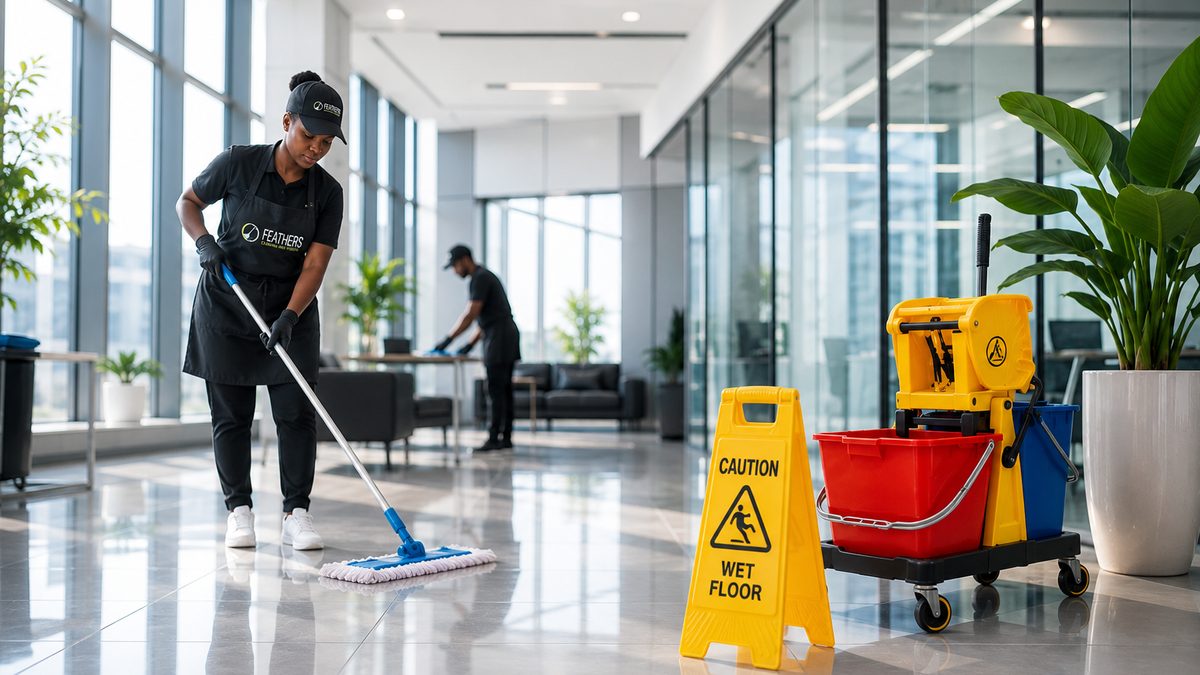
From consistent standards to built-in cover and compliance documentation.
Outsourcing office cleaning is one of those decisions that businesses postpone for years and then wonder why they waited. It usually gets framed as a cost question — "can we afford a contractor?" — when the more useful question is whether the current arrangement is actually costing less, once you count everything.
Here are nine reasons businesses move to a professional office cleaning company, along with an honest note on where outsourcing does not make sense.
1. Consistent Standards Instead of Variable Effort
The core problem with informal cleaning arrangements is not effort — it is consistency. When cleaning is a secondary responsibility layered onto someone's actual job, or handled by a single person with no backup, standards drift. Some weeks are excellent. Some weeks the bathrooms get missed.
A professional contractor works to a written scope with defined frequencies. Every task has a stated interval, a stated method and a supervisor accountable for it. That is what turns cleaning from an activity into a standard.
2. Trained Method — Which Prevents Damage as Much as It Delivers Cleanliness
This is the reason most under-appreciated by businesses and most obvious to anyone who cleans professionally. Untrained cleaning does not simply achieve less; it actively causes damage.
- Wrong chemical on the wrong substrate — acidic cleaners on natural stone, solvent-based products on powder coating, bleach on grout sealant
- Over-wetting timber and laminate flooring — causes swelling and edge lift that cannot be reversed
- Dry-wiping abrasive dust across glazing — produces permanent micro-scratching, particularly relevant in Gqeberha given local dust conditions
- Cross-contamination — the same cloth moving from bathroom to kitchen, which is a genuine hygiene failure rather than an aesthetic one
- Incorrect dilution — either ineffective or leaving residue that attracts more soiling
Damage caused by incorrect cleaning method usually surfaces months later as a replacement or refinishing cost, and it is almost never traced back to its actual cause.
3. Reduced Sick Days and Absenteeism
Shared office environments concentrate transmission. Keyboards, phones, door handles, lift buttons, kitchen taps and shared equipment are touched repeatedly by many people every day, and the standard end-of-day tidy does not address any of them.
Proper disinfection of high-touch points, at a frequency matched to occupancy, is one of the highest-return activities in any cleaning specification. It is also one of the most commonly omitted from informal arrangements, because it is not visually obvious — nobody looks at a door handle and can tell whether it was disinfected.
A note on claims
We are not going to quote you a percentage reduction in sick days. The published research varies widely by setting, methodology and baseline, and any single figure would be misleading. What we can say plainly: high-touch surfaces are a known transmission route in shared workplaces, and systematically disinfecting them is standard practice for good reason.
4. Your Staff Get Their Actual Jobs Back
In smaller businesses, cleaning frequently lands on whoever is most conscientious. That person is usually also the one doing the most valuable work. Asking a bookkeeper, an office administrator or an operations lead to spend forty minutes a day on cleaning is one of the more expensive ways to buy cleaning services.
Run the number honestly: hours per week, multiplied by the actual cost of that person's time, annualised. Most businesses are surprised by the result — and it does not yet include the management time spent supervising, sourcing supplies and handling complaints.
5. Equipment and Consumables Are Not Your Problem
Doing the job properly requires more than a mop and a bucket:
- Commercial vacuum equipment with appropriate filtration
- Floor machines — scrubbers, polishers, buffers
- Carpet extraction equipment
- Window cleaning equipment and access apparatus
- Colour-coded cloth and mop systems to prevent cross-contamination
- Correctly stored, correctly labelled chemical stock with safety data sheets
Buying that equipment is a capital decision. Maintaining, storing, servicing and eventually replacing it is a recurring one. Under a contract, all of it sits with the contractor.
6. Cover Is Built In
When your one cleaner is ill, on leave, or resigns, an in-house arrangement simply stops. The office does not get cleaned, or someone else absorbs it on top of their own work.
A contractor is obliged to deliver the scope regardless of who is available. Absence, leave and turnover become the contractor's operational problem rather than yours. For businesses that have lived through a cleaner resigning without notice, this alone often justifies the change.
7. Compliance and Documentation You Can Actually Produce
Employers carry the obligation to maintain a safe, hygienic workplace, and increasingly the obligation to demonstrate that they have. A credible contractor provides:
- COIDA registration and UIF compliance for their staff
- Valid public liability insurance
- Tax compliance documentation
- Safety data sheets for all chemicals used on your site
- A documented cleaning schedule with recorded completion
- Trained staff with recorded induction
Informal arrangements rarely produce any of this, and the gap only becomes visible during an inspection, an incident investigation or an insurance claim — which is the worst possible moment to discover it.
8. Premises Condition Is a Commercial Signal
Clients, suppliers, prospective employees and inspectors all form a judgement about your business from your premises, generally within the first minute. Reception glazing, flooring condition, bathroom standards and air quality all feed that judgement whether you intend them to or not.
This matters more in the Eastern Cape than in more anonymous markets, because business here runs heavily on relationships and referral. A well-maintained older building consistently reads better than a neglected new one.
9. Building Fabric and Assets Last Longer
Cleaning is a maintenance function. Correctly maintained flooring, upholstery, glazing and fixtures last materially longer than neglected ones.
| Asset | Effect of Correct Cleaning |
|---|---|
| Carpet | Regular extraction removes abrasive grit that cuts fibres underfoot |
| Hard flooring | Correct sealing and treatment prevents wear reaching the substrate |
| Upholstery | Scheduled cleaning prevents soiling becoming permanent staining |
| Glazing | Correct wet method prevents micro-scratching from abrasive particulate |
| HVAC | Filter and intake maintenance reduces system load and energy draw |
| Metal fixtures | Regular cleaning slows salt-air corrosion in coastal locations |
Deferring cleaning does not save money. It converts a predictable operating cost into an unpredictable capital one.
When Outsourcing Is Not the Right Call
An honest counterweight, because this decision is not universal:
- Very small premises with low occupancy. A two-person office may genuinely be better served by a straightforward internal arrangement.
- You already have a competent, well-equipped, reliable in-house team. If it works, changing it introduces risk for no clear gain.
- Highly restricted-access environments. Sites with severe security or confidentiality constraints may need in-house staff regardless of cost — though many contractors can work within vetting requirements.
- Genuinely irregular occupancy. Premises used a few days a month may not justify a contracted frequency.
The useful test is not "which is cheaper on paper." It is: are your standards consistent, is your method competent, is cover in place, and can you produce documentation if asked? If the answer to any of those is no, outsourcing is worth costing properly.
How to Compare Quotes Properly
Cleaning quotes are notoriously difficult to compare because contractors scope differently. To get a genuine comparison, insist that every quote states:
- Every task, with its frequency (daily, weekly, monthly, quarterly)
- Number of staff attending and hours on site
- Whether consumables — hand soap, paper, bin liners — are included or billed separately
- Which periodic tasks are included versus quoted separately (carpet extraction, external glazing, floor treatment)
- Who supervises, and how often they attend
- Compliance documentation: COIDA, UIF, insurance, tax clearance
- Notice period and escalation process
A quote that is simply a monthly figure with no scope is not a quote. It is a number, and it will be the source of every dispute that follows.
The Bottom Line
The case for outsourcing office cleaning rests on consistency, competent method, built-in cover, compliance documentation and asset preservation — not simply on the headline monthly rate. Once the full cost of an in-house arrangement is counted, including management time and the cost of damage from incorrect method, the comparison usually looks different from the initial assumption.
It is not the right answer for every business, and we have set out above where it is not. But if your standards vary week to week, your cover is one person deep, or you could not produce a cleaning record if asked — it is worth costing properly.
Feathers Cleaning and Hygiene provides office and commercial cleaning across Gqeberha, East London, Mthatha and the wider Eastern Cape, with written scopes and defined frequencies.
Want this handled properly?
Tell us what you need cleaned and we will come and look at it before quoting anything.
Request a Written Scope Or call 079 096 3267