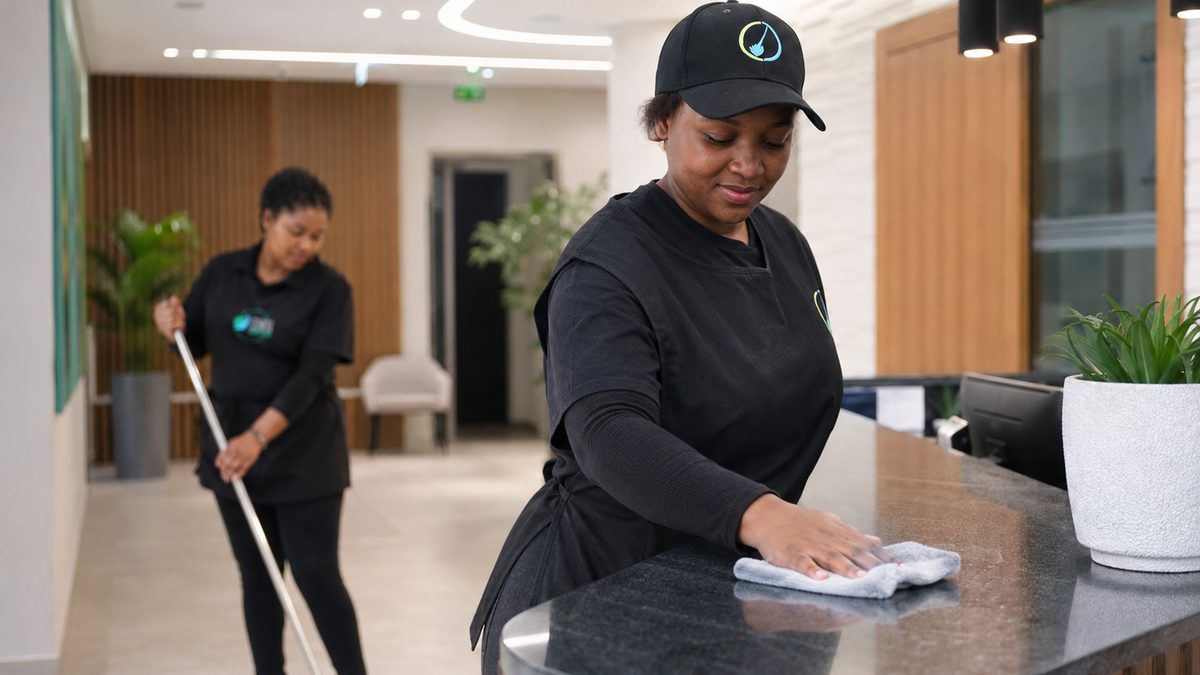
Looks clean and is hygienic are two different standards.
Walk into most offices in Gqeberha at eight in the morning and they look clean. Bins emptied, floors vacuumed, surfaces clear. The problem is that "looks clean" and "is hygienic" are two different standards, and the gap between them is where workplace illness lives.
The surfaces that transmit the most are almost never the surfaces that look the worst. A visibly dusty windowsill is a cosmetic issue. A keyboard that has never been disinfected, used by three different people across two shifts, is a transmission route. Routine tidying addresses the first and ignores the second entirely.
Why "Looks Clean" and "Is Clean" Diverge
Professional office cleaning needs to account for more than visual outcomes because visual outcomes are what usually get inspected. Nobody walks into an office and audits door handles. They look at the floor, the bins and the reception desk.
That creates a predictable blind spot. Cleaning effort concentrates on large visible surfaces — flooring, desks, glass — while the small, frequently-touched, high-transmission items receive little or no attention. The result is an office that photographs well and still circulates whatever is going around.
On the numbers you have probably seen
You have likely encountered the claim that an office desk carries a specific multiple of the bacteria found on a toilet seat. We are not going to repeat a figure, because the widely-circulated versions trace back to studies with different methodologies, sample sizes and definitions, and the number shifts depending on which one you cite. The underlying point is sound and worth stating plainly: toilet seats are cleaned and disinfected routinely and deliberately, and desks generally are not. That is the actual insight. The multiplier is decoration.
Where the Germs Actually Are
Across the commercial sites we service, the same categories come up consistently. These are the surfaces where transmission risk concentrates.
Personal workstation items
- Keyboards — the single most-handled item at any desk, rarely disinfected, and a collection point for food debris, skin cells and whatever was on the user's hands. Hot-desking multiplies the problem.
- Mouse and trackpad — continuous skin contact throughout the working day
- Desk phone handset and keypad — direct face and mouth contact, shared in many layouts
- Mobile phones on the desk — technically personal, practically a reservoir that moves between the desk, the bathroom, the kitchen and the car
- Desk surface itself — where food is frequently eaten despite policies to the contrary
- Chair armrests — constant hand contact, almost never cleaned
Shared equipment
- Printer and copier control panels — touched by everyone, cleaned by no one
- Shared laptops, tablets and presentation remotes
- Meeting room table surfaces — back-to-back bookings mean no reset between groups
- Whiteboard markers and erasers
- Stationery in communal trays
Building touch points
- Door handles and push plates — particularly on bathroom and kitchen doors, which are touched immediately after hand contact with contaminated surfaces
- Light switches
- Lift buttons and stairwell handrails
- Access control keypads and biometric readers — everyone in the building touches these, often twice daily
- Reception counter edge — where visitors rest hands while signing in
Kitchen and break areas
This is consistently the highest-risk zone in an office, and consistently the least well-managed, because responsibility for it is ambiguous.
- Kitchen sponges and dishcloths — damp, warm, organically loaded, and frequently used far beyond their useful life
- Tap handles — touched with dirty hands before washing, and again after
- Microwave door handle and keypad — combined with food splatter inside
- Kettle handle and switch
- Fridge door handle, and the fridge interior, which in most offices operates on a "nobody's job" basis
- Communal mugs and the drying rack
Bathrooms
- Door handles on the inside — the last thing touched before leaving
- Tap handles and soap dispenser pumps
- Cubicle locks and door edges
- Hand dryer buttons
- Sanitary bin lids
Why This Matters Beyond Discomfort
The business case for workplace hygiene rests on three practical outcomes.
Illness transmission and absence
Shared workplaces concentrate contact. Respiratory and gastrointestinal illness moves through an office efficiently, and the pathway is usually hand-to-surface-to-hand rather than anything more dramatic. Systematic disinfection of high-touch points interrupts that pathway. It does not eliminate illness, and we would not claim it does — but it removes one of the main routes.
Presenteeism
The more expensive problem is not staff who stay home. It is staff who come in unwell, work at reduced capacity, and infect colleagues. In South African workplaces, where sick leave entitlement is finite and pressure to attend is real, presenteeism is common. Reducing transmission reduces the number of people in that position.
Air quality and general wellbeing
Dust accumulation, poorly maintained HVAC filters and inadequate ventilation contribute to headaches, fatigue and irritation that rarely get formally reported but consistently affect output. In Gqeberha this is compounded by local industrial dust deposition, which loads filters faster than standard service intervals assume. We cover that in detail in our guide to manganese dust in Port Elizabeth.
The Difference Between Cleaning, Sanitising and Disinfecting
These three words get used interchangeably in cleaning quotes, and they mean different things. If your specification does not distinguish between them, you do not actually know what you are buying.
| Term | What It Does | Where It Applies |
|---|---|---|
| Cleaning | Physically removes soil, dust and debris from a surface. Does not kill organisms, but removes many along with the soil. | All surfaces — this is always the first step |
| Sanitising | Reduces organisms on a surface to a level considered safe. | Food preparation surfaces, kitchen areas |
| Disinfecting | Kills organisms on a surface, using a product left in contact for a specified dwell time. | High-touch points, bathrooms, shared equipment |
The dwell time problem
This is the most common failure in practice, and it is invisible to anyone inspecting the result. Disinfectants require a stated contact time — the surface must remain wet with product for that period to be effective. Spraying a door handle and immediately wiping it dry does not disinfect it. It cleans it, and the product is wasted.
Trained cleaning staff know the dwell time for the products they use and structure their route so surfaces stay wet long enough. Untrained staff spray and wipe, because that is what looks efficient. The difference does not show up in inspection; it shows up in transmission.
What a Competent Office Hygiene Specification Includes
Daily
- All high-touch points disinfected with observed dwell time: door handles, push plates, light switches, lift buttons, handrails, access keypads
- Bathrooms — full clean, disinfection and restock
- Kitchen and break area — surfaces, taps, appliance handles, sink
- Reception counter and entrance glazing touch areas
- Waste removal, including kitchen and sanitary waste
- Colour-coded cloth system to prevent cross-contamination between zones
Weekly
- Workstation detail — desk surfaces, chair armrests, monitor edges
- Shared equipment — printers, copiers, meeting room tables and controls
- Internal glazing and partitions
- Fridge interior on a defined rotation with a stated policy for unlabelled items
- Skirtings, vents and low-level detail
Monthly to quarterly
- High-level dusting — light fittings, ceiling vents, upper shelving
- Carpet extraction and upholstery cleaning
- Hard floor treatment appropriate to substrate
- Behind and beneath fixed furniture
- HVAC grille and intake cleaning, coordinated with filter servicing
The colour-coding standard
Any credible contractor uses a colour-coded cloth and mop system — typically separating bathroom, kitchen, general surface and glass. The purpose is to make cross-contamination physically impossible rather than dependent on someone remembering. If a prospective contractor cannot explain their colour-coding system on the spot, that tells you something about their training standards.
What Staff Can Do — And What They Genuinely Cannot
Individual responsibility helps, and it has limits worth being honest about.
Reasonable to expect from staff:
- Wiping their own keyboard, mouse and phone weekly with an appropriate wipe
- Clearing food debris from their desk daily
- Washing and putting away their own mug rather than leaving it in the sink
- Reporting bathroom or kitchen issues rather than working around them
- Hand hygiene, particularly before eating and after bathroom use
Not reasonable to expect from staff:
- Disinfecting shared building touch points with correct dwell time
- Cleaning bathrooms to any hygiene standard
- Managing the fridge and kitchen as a shared resource — this reliably fails without assigned ownership
- High-level cleaning, HVAC grilles or anything requiring access equipment
- Carpet extraction or hard floor treatment
Where businesses go wrong is assuming the second list will happen because the first list is achievable. It will not. The second list needs assigned, trained, equipped responsibility.
Quick Self-Audit: Ten Questions
Run this on your own premises. If you answer no to more than three, your specification has gaps.
- Are door handles and light switches disinfected daily, with a product left to dwell?
- Does your cleaning team use a colour-coded cloth system?
- Is there a named person or contractor responsible for the fridge interior?
- Are kitchen sponges and cloths replaced on a defined schedule?
- Are shared printers and copier panels cleaned at any stated frequency?
- Are meeting room tables reset between bookings?
- Do you know the dwell time of the disinfectant used in your bathrooms?
- Are HVAC filters inspected on observation rather than only on calendar interval?
- Do you have a written cleaning scope with frequencies against each task?
- Could you produce a cleaning record if an inspector or insurer asked for one?
The Bottom Line
Offices are not dirty in the way people imagine. They are dirty in a specific, predictable pattern: large visible surfaces get attention, small high-contact surfaces do not, and shared kitchens and bathrooms fall into the gap between individual and organisational responsibility.
Fixing it does not require more cleaning hours. It requires a specification that names high-touch points explicitly, distinguishes cleaning from disinfecting, respects dwell time, and assigns clear ownership for shared areas.
Feathers Cleaning and Hygiene provides office and commercial cleaning across Gqeberha, East London, Mthatha and the wider Eastern Cape, working to written scopes with defined frequencies.
Want this handled properly?
Tell us what you need cleaned and we will come and look at it before quoting anything.
Request a Written Scope Or call 079 096 3267