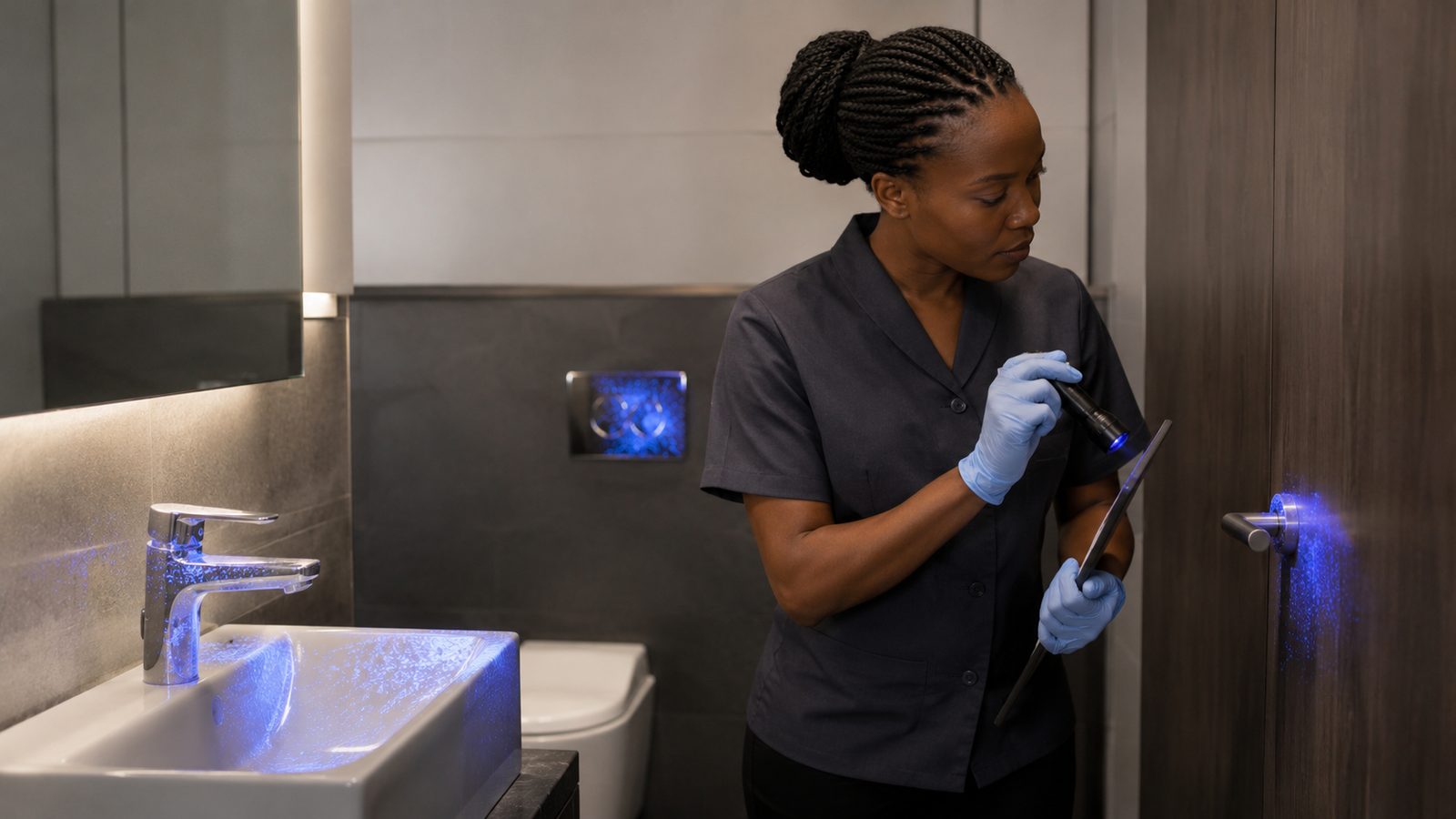
The washroom is the highest-risk shared space in most workplaces and the one most often cleaned to the lowest standard.
Every person in the building uses it, most of them several times a day, and almost every surface in it is touched by hand. When washroom hygiene slips it does not stay in the washroom — it travels out on hands, onto door handles, onto keyboards and into the kitchen.
What Is Actually Being Managed
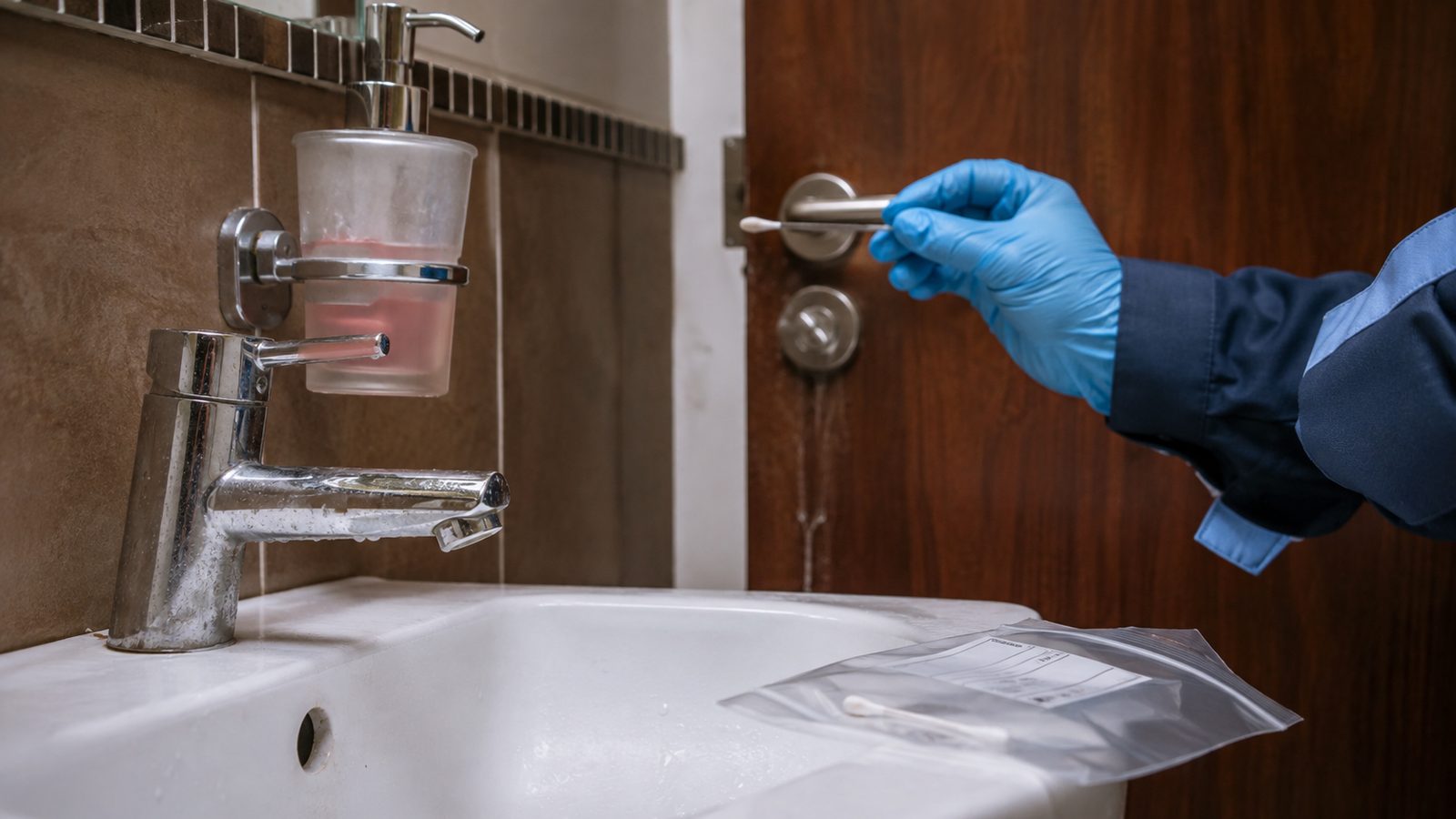
- Bacteria. Organisms associated with faecal contamination and skin-borne bacteria concentrate on taps, flush handles, cubicle locks and door furniture.
- Viruses. Gastrointestinal and respiratory viruses transmit efficiently in shared washrooms, and some survive on hard surfaces long enough to matter between cleaning cycles.
- Mould and fungi. Damp grout, ceilings above showers, and under-sink areas give mould exactly the conditions it needs.
- Aerosol spread. Flushing an uncovered toilet disperses fine droplets into the surrounding air, which then settle on nearby surfaces including dispensers, taps and door handles.
The last point is the one that reorders a cleaning routine: the surfaces nearest the toilet are contaminated by the toilet, whether or not anyone touched them with dirty hands.
The Business Cost
- Absenteeism, which is the direct and measurable one
- Staff perception — washroom condition is read as a statement about how the employer regards them, fairly or not
- Visitor perception, formed in under a minute and rarely revised
- Blocked drains, odour and accelerated fitting damage, all of which cost maintenance money
- A weak position if hygiene standards are ever examined in a compliance context
The Controls That Matter
Reduce the number of touch points
Sensor taps, sensor soap dispensers, sensor or foot-operated flush and touch-free drying remove several of the highest-contamination contact points entirely. Where a full refit is not viable, the single highest-value change is the exit door — a door that pulls open with a clean hand, or a bin placed at the door for paper towel, undoes the handwashing that just happened.
Never run out
Soap, toilet paper and hand drying are not amenities. An empty soap dispenser converts a functioning hygiene control into a decorative one. Restocking should be a named, checked task with a signature, not something noticed when someone complains.
Sanitary waste through the right route
Every female washroom needs serviced sanitary units, emptied on a defined cycle and disposed of through a licensed route. General waste bins are not a substitute and create both a plumbing risk and a dignity problem. This is normally a separate specialist appointment rather than something a cleaning contractor absorbs — Feathers does not provide it — so the point to check is that somebody holds it and that the cycle is written down.
Deep cleaning, not just wiping
Floors, walls, partitions, grout, urinal traps and the underside of fittings need periodic deep cleaning and descaling. Surface wiping keeps a washroom presentable; it does not keep it hygienic, and it does not deal with the odour source.
Ventilation
An extractor that does not work, or vents into a ceiling void, guarantees a humidity problem and a mould problem regardless of how well the room is cleaned.
Dwell time again
The most common washroom cleaning failure is not a missed surface. It is disinfectant applied and immediately wiped off. Every disinfectant needs contact time to work, and a cleaner moving quickly through a two-cubicle washroom is often wiping it dry within seconds. This is a method and training issue, not a product issue, and it is invisible in an inspection that only looks at appearance.
Frequencies That Work
| Setting | Working frequency |
|---|---|
| High-traffic public or retail washroom | Checked and serviced through the day, several times |
| Standard office washroom | At least twice daily, with a restock check |
| Floors and walls | Weekly deep clean |
| Descaling and grout | Monthly |
| Sanitary units | On a defined service cycle, set by usage |
The Bottom Line
Washroom hygiene is a health control, a maintenance control and a signal to everyone who works in or visits the building. It responds to the ordinary things done properly: touch points reduced, consumables never empty, sanitary waste routed correctly, deep cleaning on a real cycle, ventilation working, and disinfectant given time to act.
Frequently Asked Questions
How long do viruses survive on washroom surfaces?
It varies considerably by organism and by surface, and some are notably persistent on hard surfaces. Rather than relying on a specific figure, the practical position is that between-cycle contamination is expected, which is why touch-point frequency and hand hygiene provision matter more than any single deep clean.
Are hand dryers or paper towels more hygienic?
Both are used widely and each has arguments in its favour. Paper towel is often preferred where the exit door has a handle, because it gives people something to open it with. What matters more than the choice is that the provision never runs out.
Do we still need a sanitary bin service if we have general waste bins?
Yes. Sanitary waste should be collected in dedicated units and removed through a licensed disposal route, both for hygiene and for the plumbing consequences when it goes into the toilet instead.
Washroom standards slipping?
Washroom cleaning, descaling and odour control on a documented cycle, with the sanitary waste arrangement specified alongside it.
Request a Washroom Scope Or call 079 096 3267