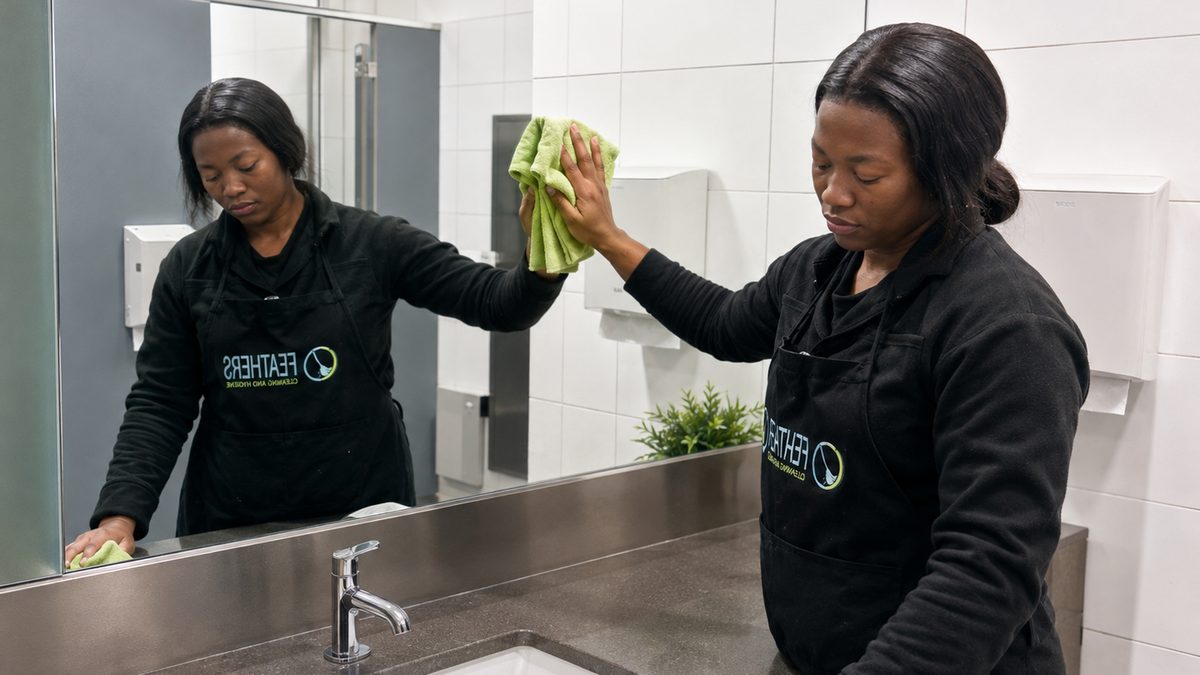
Persistent odour has a findable physical source.
Persistent bathroom odour in an office is unusually frustrating because the obvious response — clean harder, add air freshener — reliably fails. The bathroom gets cleaned daily, the smell comes back within hours, and everyone concludes it is simply how the building is.
It is not. Odour has a physical source, and if cleaning the visible surfaces is not resolving it, the source is somewhere you are not cleaning. This guide covers how to find it.
First Principle: Masking Is Not Removing
Air fresheners, aerosols and plug-in units add a fragrance on top of an odour. They do not remove the source, and the combination is frequently worse than the original smell — the classic office bathroom signature of floral fragrance over something organic.
The sequence that works is: find the source, remove it physically, then treat any residue biologically. Fragrance, if used at all, comes last and only once the source is gone.
Diagnose by Smell Type
The character of the odour usually tells you where to look.
| What It Smells Like | Most Likely Source |
|---|---|
| Ammonia, sharp, worse in warm weather | Urine residue — floor around pan bases, grout, behind urinals, pan-to-floor seal |
| Sewage, drains, sulphurous | Dry trap, damaged seal, or a venting problem |
| Musty, damp, earthy | Mould — behind cisterns, in grout, ceiling, or wet cloths and mops |
| Sweet, stale, organic | Biofilm in drains, or sanitary waste |
| Comes and goes unpredictably | Ventilation drawing from elsewhere, or a trap drying between uses |
| Worse first thing Monday | Dry trap — classic weekend evaporation pattern |
The Five Most Common Sources
1. Urine residue below the fixture, not in it
The most common cause by a distance. Urine splash lands on the floor around the pan or urinal base, runs into the pan-to-floor junction, and soaks into grout and any gap in the seal. The pan itself is cleaned daily; the junction beneath it rarely is.
Once urine has penetrated grout or an unsealed floor junction, surface cleaning does nothing — the source is below the surface. The odour intensifies with warmth and humidity, which is why it seems worse in summer.
Treatment: clean the junction thoroughly, apply an enzyme treatment that breaks down the residue rather than just cleaning over it, allow full dwell time, and reseal the pan-to-floor junction once dry. Where grout is heavily contaminated, regrouting may be the only real fix.
2. Dry traps
Every drain has a water trap that blocks sewer gas. If the water evaporates, the barrier is gone and drain odour comes straight up.
Traps dry out in floor gullies that are rarely used, in basins in low-traffic areas, in facilities closed over weekends or shutdown periods, and in hot dry conditions.
Diagnosis: the odour is sewage-like, and it is strongest first thing after a period of non-use.
Treatment: run water into every drain and gully, including the ones nobody uses. Where a trap dries repeatedly, a trap seal device or a scheduled water-charging routine solves it permanently.
3. Drain biofilm
A layer of organic material builds up on the internal walls of waste pipes — soap, skin cells, hair, general organic matter. It produces a sweet, stale odour that is strongest near basins and floor drains, and it does not respond to surface cleaning because it is inside the pipe.
Treatment: enzyme or bacterial drain treatments applied at the end of the day, so they sit in the pipe overnight rather than being flushed straight through. This usually needs repeating over several applications rather than working in one go.
Bleach is not the answer here. It passes through too quickly to break down established biofilm, and it kills the bacterial cultures in enzyme products if you are using both.
4. Inadequate extraction
Ventilation removes both odour and the moisture that feeds mould. When it underperforms, both accumulate.
Common failures:
- Extraction wired to the light switch, so it stops the moment the room empties
- Fan grille clogged with dust, drastically reducing airflow
- Ducting blocked, disconnected, or discharging into a ceiling void rather than outside
- Fan running but under-specified for the room volume
- No make-up air path, so the fan cannot actually move air
Quick test: hold a sheet of tissue paper against the grille with the fan on. If it does not hold firmly in place, the extraction is not doing its job.
Treatment: clean the grille, verify the duct run discharges externally, fit a run-on timer or humidity sensor, and ensure air can enter the room — usually a gap under the door.
5. Sanitary waste and general bins
Sanitary units need a proper disposal service with a defined collection frequency, not an internal arrangement. Under-serviced units are a common and easily fixed odour source.
Also check: bin bodies as well as liners, the underside of bin lids, and any bin without a liner at all.
The Sources People Miss
If the five above do not resolve it, look here:
- Behind and beneath the cistern — accumulation and mould in a spot nobody inspects
- Cistern overflow and internal components
- The cleaner's own cloths and mops — a mop left damp in a bucket is a genuinely common source of a musty smell that follows the cleaning round
- The cleaning store cupboard, particularly if it is adjacent and shares ventilation
- Ceiling voids where extraction discharges incorrectly, or where a leak has occurred
- Degraded sealant around basins, pans and trays, letting water behind the fitting
- Urinal traps and strainers, which scale up and hold residue
- Waterless urinal cartridges, which have a service life and fail noticeably when exceeded
- Floor drains under fixed fittings, sometimes hidden by later refurbishment
A Systematic Investigation
Work through this in order rather than treating symptoms.
- Enter first thing, before cleaning and before use. Odour is at maximum concentration and undiluted by cleaning products.
- Note the character of the smell and match it to the table above.
- Locate the strongest point. Move around the room at floor level — most sources are low.
- Check floor junctions around every pan and urinal base, and the condition of the grout there.
- Pour water into every drain and gully, including unused ones. Wait a day and reassess.
- Test extraction with the tissue paper method.
- Inspect behind and beneath every fixture, including behind the cistern.
- Check sealant condition at every water-facing junction.
- Inspect the cleaning equipment and store.
- Change one thing at a time and reassess, so you learn what actually worked.
What to Use — And What Not To
| Product Type | Use For | Notes |
|---|---|---|
| Enzyme or bacterial treatment | Urine residue, drain biofilm | Needs long dwell; apply at end of day; repeat applications |
| Acidic descaler | Scale in pans, urinals, traps | Never mix with bleach; check substrate compatibility |
| Disinfectant | High-touch points, surfaces | Observe stated dwell time or it does nothing |
| Bleach | Limited use on surfaces | Does not clear biofilm; kills enzyme cultures; degrades some sealants and grout |
| Air freshener | Nothing, until the source is gone | Masks rather than removes; can worsen the result |
One safety point
Never mix acidic descalers with bleach or chlorine-based products. The combination releases chlorine gas, which is genuinely dangerous in a small, poorly ventilated room. This is not a theoretical risk — it is a recurring cause of injury in cleaning work. If both are used in the same space, they must be separated by a full rinse.
Preventing Recurrence
- Include floor junctions around pan and urinal bases in the daily scope explicitly
- Schedule enzyme drain treatment on a regular cycle rather than only when there is a problem
- Fit run-on timers or humidity sensors to extraction
- Charge unused drains and gullies with water on a routine
- Inspect and renew sealant annually
- Descale weekly rather than allowing scale to establish
- Ensure cloths and mops are laundered and dried, never stored damp
- Service sanitary units at a frequency matched to actual usage
When It Is Not a Cleaning Problem
An honest limit. Some causes cannot be cleaned away and need a plumber or building contractor:
- Damaged or displaced soil pipe seals
- Cracked pans or damaged pan connectors
- Missing or inadequate soil vent pipe
- Ducting disconnected inside a ceiling void
- Waste pipe falls that do not drain properly
- Failed waterproofing behind tiling
- Grout so contaminated that only replacement resolves it
A competent cleaning contractor should be able to tell you when you have crossed this line, rather than continuing to sell you treatments that cannot work.
The Bottom Line
Persistent office bathroom odour is a source problem, not a cleaning-frequency problem. In most cases it is urine residue in floor junctions and grout, a dry trap, drain biofilm, failing extraction, or under-serviced sanitary waste — and each has a specific, findable fix.
Diagnose before you treat, work through the sources in order, change one thing at a time, and leave fragrance until after the source is gone. If it is a plumbing or building fault, no cleaning regime will resolve it and you need the right trade.
Feathers Cleaning and Hygiene provides washroom hygiene and specialised cleaning services across Gqeberha, East London, Mthatha and the wider Eastern Cape.
Want this handled properly?
Tell us what you need cleaned and we will come and look at it before quoting anything.
Request a Written Scope Or call 079 096 3267