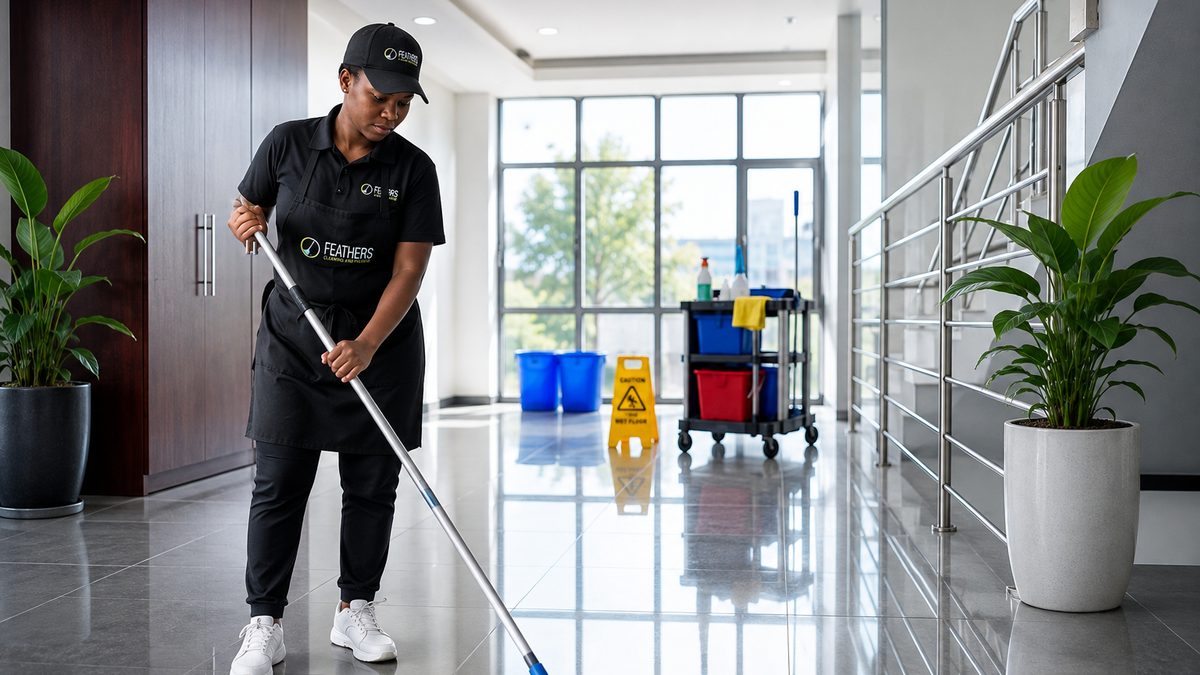
Visitors assess your reception within seconds.
Your reception is the only part of your business that every visitor experiences. Clients, prospective clients, suppliers, job candidates, auditors and inspectors all pass through it, and they all form a judgement there before anyone has said a word to them.
That judgement is not really about cleanliness. It is about competence. A visitor who notices a marked floor and a dusty windowsill is not concluding that you clean badly — they are wondering what else you let slide. The reception is read as a sample of the whole operation.
In the Eastern Cape, where business runs heavily on relationships and referral, that reading travels further than it does in more anonymous markets.
What Visitors Actually Notice
Not what you might assume. The elements that register, roughly in order:
- Smell. Registered first, before anything is consciously assessed, and almost never articulated. A stale, damp or chemical odour sets the frame for everything that follows.
- Floor condition. The largest visual surface in the room. Scuffing, tracked-in dust, dull finish and marks around the entrance read as neglect immediately.
- Entrance glazing. Physically the first thing touched and looked through. Fingerprints at handle height and haze on the glass are highly visible.
- Whether the space feels attended to. Straight seating, cleared surfaces, current signage, working lights. This is about order as much as cleanliness.
- Seating condition. Visitors sit down and look closely at what is next to them.
- Bathrooms, if they use them. The single most-cited factor in visitor perception of a business's standards.
The thing most businesses get wrong
Reception is usually cleaned first, early in the morning, before the building fills up. By the time visitors actually arrive — mid-morning through afternoon — it has absorbed several hours of foot traffic. The clean is real; the timing is wrong. A well-scoped office cleaning service can account for this with a short mid-day reset on the entrance floor and glazing rather than simply adding hours to the early shift.
The Areas That Carry Most Weight
Entrance and threshold
- Entrance matting — the highest-value item in the whole reception. Matting captures tracked-in grit and moisture before it reaches your flooring. A saturated or clogged mat has stopped working and is now a source rather than a control.
- Glazing and door furniture — handles, push plates and glass at hand height
- Threshold strip and door tracks — accumulate debris and are rarely detailed
- The immediate area outside the door — visitors form the impression before they enter
Flooring
- Traffic lane through the entrance — wears and soils faster than anywhere else in the building
- Edges, corners and the area behind the door
- Under and between seating
- Any transition strip between flooring types
- Slip management — wet floor signage placement and removal
Reception counter
- Counter surface and, importantly, the front edge where visitors rest hands and elbows
- Visitor-side of the counter, which is frequently missed because cleaning is done from the staff side
- Signing-in equipment, pens and any shared tablet or terminal
- Card machine and access keypad
- Behind and beneath the counter — visible from a standing visitor's angle in most layouts
Seating and waiting area
- Upholstery, including between and beneath cushions
- Chair and sofa legs, bases and castors
- Side tables, magazine racks and their contents — out-of-date material is its own signal
- Beneath and behind seating, which accumulates continuously
- Any water station, coffee point or refreshment area
Vertical surfaces and detail
- Walls at hand and shoulder height, particularly beside doors and along corridors
- Signage, plaques and wayfinding — dusty signage is very visible
- Skirting boards
- Light fittings and diffusers — dust here dims the room measurably
- Air vents and grilles, which show staining first
- Plants, real or artificial — dusty artificial foliage is worse than none
Local Factors in Gqeberha
Reception areas in Nelson Mandela Bay face two specific pressures that inland premises do not.
Industrial dust deposition settles on entrance glazing, signage and horizontal surfaces faster than standard schedules assume, and it is abrasive — dry-wiping it across glass causes permanent micro-scratching. Reception glazing needs a wet method, and it needs it more often here. Our guide to manganese dust in Port Elizabeth covers this in detail.
Coastal air and humidity produce a film on external glazing that internal cleaning does not resolve, and accelerate corrosion on door furniture, security gates and external signage. Buildings with large glass frontages need external glazing treated as a recurring item rather than an annual one.
A Practical Reception Standard
Daily
- Entrance glazing including handles, push plates and hand-height glass
- Entrance matting vacuumed or cleaned; checked for saturation
- Floor swept and mopped, with attention to the entrance traffic lane
- Counter surface and visitor-side edge cleaned and disinfected
- Seating wiped; cushions straightened
- Waste emptied
- High-touch points disinfected — door handles, keypads, signing-in equipment
- Visual reset: signage straight, magazines current, lights working
Mid-day reset (10–15 minutes, high-value)
- Entrance glazing at hand height
- Entrance floor traffic lane
- Counter surface
- Seating straightened
Weekly
- Full floor detail including edges, corners and behind the door
- Under and between seating
- Behind and beneath the reception counter
- Skirtings, door frames and vertical surfaces at hand height
- Signage, plaques and wayfinding
- Plants dusted or wiped
Monthly to quarterly
- External glazing — more frequently in coastal-facing or high-deposition positions
- Upholstery deep clean
- Hard floor treatment or carpet extraction
- High-level dusting — light fittings, vents, tops of partitions
- Entrance matting deep clean or replacement assessment
The Five-Minute Self-Audit
Walk in through your own front door as a visitor would — from outside, at the time of day your visitors actually arrive.
- Stop outside. What does the entrance look like from the pavement or car park?
- Look at the glass at hand height as you push the door.
- Pause inside for five seconds. What do you smell?
- Look down at the floor in the traffic lane.
- Sit in a visitor chair. Look at the side table, the floor beneath you, and the seat next to you.
- Look up. Light fittings, vents, tops of partitions.
- Look at the front of the counter, not the top.
- Use the visitor bathroom.
Anything you notice, a visitor notices. The difference is that they will not tell you.
What This Is Not About
One honest clarification, because this topic attracts overstatement. This is not an argument for refurbishment, expensive furniture or design spend. A well-maintained older reception consistently reads better than a neglected new one. Visitors are not assessing your budget — they are assessing whether the space looks attended to.
Consistency is the whole point. A reception that is immaculate on Monday and tired by Thursday sends a worse signal than one that is consistently decent, because inconsistency reads as effort applied for show.
The Bottom Line
Your reception is the sample of your business that every visitor takes. Smell, floor condition, entrance glazing and general order do most of the work, and the bathroom finishes the job.
Getting it right is not about spending more. It is about naming the front-of-house areas explicitly in your cleaning scope, timing the work around when visitors actually arrive rather than when the building opens, and holding the standard consistently rather than intensively.
Feathers Cleaning and Hygiene provides front-of-house and full commercial cleaning across Gqeberha, East London, Mthatha and the wider Eastern Cape.
Want this handled properly?
Tell us what you need cleaned and we will come and look at it before quoting anything.
Request a Written Scope Or call 079 096 3267