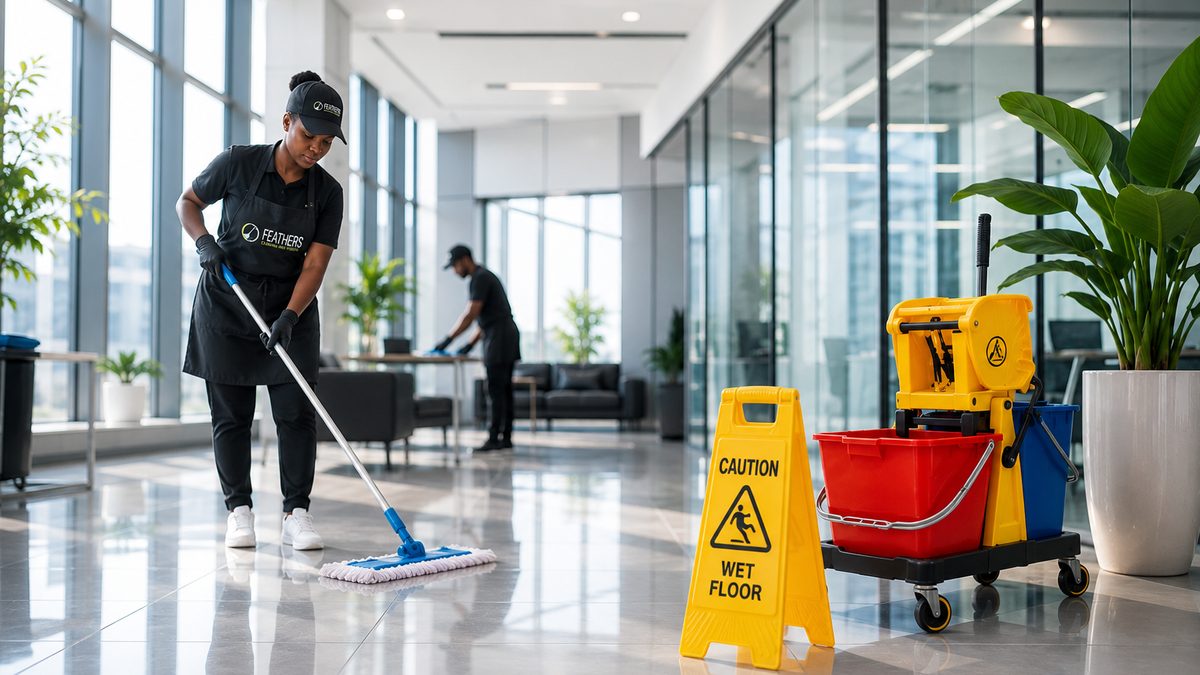
The same five areas get missed in office after office.
Every office cleaning schedule has gaps, and they are remarkably consistent from one business to the next. The same five areas get missed, for the same structural reason: they are either not visible from standing height, not obviously anyone's responsibility, or not on the written scope because nobody thought to put them there.
None of these require additional cleaning hours to fix. They require the schedule to name them explicitly. Here is what gets skipped, why, and what it costs.
1. High-Touch Points: Handles, Switches and Keypads
Why they get missed
Because they are small and they never look dirty. A door handle does not accumulate visible soil. Cleaning effort follows visual feedback, and these surfaces give none — so they get wiped occasionally at best, and disinfected almost never.
What is on the list
- Door handles, push plates and kick plates — especially on bathroom and kitchen doors
- Light switches and dimmer controls
- Lift buttons, both inside and on each landing
- Stairwell handrails
- Access control keypads, card readers and biometric scanners
- Reception counter edge, where visitors rest hands while signing in
- Meeting room door handles and AV control panels
- Vending machine and coffee machine buttons
What it costs
These are the primary hand-to-surface-to-hand transmission route in a shared workplace. Bathroom door handles are the highest-risk item on the list, because they are the last thing touched before someone returns to a shared space.
The dwell time trap
Spraying a handle and immediately wiping it dry does not disinfect it — it cleans it. Disinfectants need to remain wet on the surface for a stated contact time to work. Trained staff structure their route so surfaces stay wet long enough; untrained staff spray and wipe because that looks efficient. The difference is invisible on inspection and entirely material in effect.
The fix
Put high-touch points on the daily scope as a named line item, with the disinfectant and its dwell time specified. Not "wipe surfaces" — an itemised list.
2. The Communal Kitchen — Specifically, the Parts Nobody Owns
Why it gets missed
Ambiguous ownership. Cleaning contractors are typically scoped to clean the kitchen surfaces and floor. Staff are assumed to manage their own items. The result is a zone where each party reasonably believes the other is handling it — and the areas in between get handled by neither.
What is on the list
- Fridge interior — the single most reliably neglected item in any office. Shelves, door seals, salad drawers and the drip channel at the back
- Microwave interior, including the roof, which is where splatter actually lands
- Kettle — the handle, the switch, and descaling the element
- Sponges and dishcloths — damp, warm and organically loaded, frequently used well past their useful life
- Tap handles — touched with dirty hands before washing and again after
- Sink drain and plughole
- Cupboard interiors and the accumulated stock of expired items
- Behind and beneath appliances — the primary pest harbourage in most offices
- Communal mug drying rack
What it costs
Kitchens are the highest-risk hygiene zone in a typical office and the main driver of pest pressure. Food debris behind a fridge supplies everything a pest population needs. Pest treatment is reactive and priced accordingly; prevention is simply competent routine cleaning.
The fix
Two decisions, both of which need to be written down:
- Assign the fridge. Either the contractor cleans it on a stated rotation, or a named internal person does. "Everyone" means no one.
- Publish a disposal policy. Unlabelled items removed on a stated day. Communicate it once, then apply it consistently.
3. Behind, Beneath and Between Fixed Furniture
Why it gets missed
Because reaching it requires moving something. Routine cleaning is time-boxed and works around obstacles. Over months, that produces a shadow map of the office: every area a vacuum head cannot reach accumulates continuously and undisturbed.
What is on the list
- Under desks — particularly beneath the pedestal and around cable trays
- Behind filing cabinets, storage units and lockers
- Beneath and behind photocopiers and printers, which also generate their own toner dust
- Between and behind seating in reception and waiting areas
- Under and behind kitchen units and appliances
- Behind doors, which are almost always open when the room is cleaned
- Corners and floor edges, which machine cleaning does not reach
- Behind and beneath server racks and comms cabinets
What it costs
Two things. Accumulated dust in these areas continuously re-suspends into the air, which loops directly back into air quality and HVAC filter loading. And these are the harbourage points for pests — dark, undisturbed, often adjacent to a food source.
The fix
Rotate it. You do not need to move every unit every week. Set a rotation — a different zone each week — so every area is reached monthly. Name the zones in the scope.
4. Air Vents, Grilles and Light Fittings
Why they get missed
Height. Anything above standing reach requires steps or access equipment, which routine cleaning is neither scoped nor equipped for. They also sit in the blind spot of ordinary sightlines — people do not look up.
What is on the list
- Air-conditioning supply and return grilles
- Extraction fan covers in bathrooms and kitchens
- Light fitting diffusers, internal and external
- Ceiling tiles around vents, where staining shows first
- Tops of partitions, cupboards and racking
- Window heads, curtain tracks and blind headrails
- Exposed ductwork, conduit and cable trays
- Sprinkler heads and smoke detector housings
What it costs
This one has a measurable operational cost. Dust on light diffusers reduces light output — over time significantly enough that offices add fittings rather than clean the ones they have. Loaded HVAC grilles and filters force systems to work harder, raising energy draw and shortening component life.
In Gqeberha the loading rate runs ahead of standard service intervals because of local industrial dust deposition. Businesses following the manufacturer's default schedule are routinely running loaded filters for weeks before replacement. We cover the local dust picture in our guide to manganese dust in Port Elizabeth.
The fix
High-level work belongs on a monthly or quarterly scope with the access method stated, and it should be coordinated with HVAC servicing rather than run independently of it. Confirm your contractor has the equipment, the competence and the insurance for working at height.
5. Personal Workstation Equipment
Why it gets missed
Ownership ambiguity again, plus genuine caution. Contractors are often instructed not to touch equipment or move items on desks — reasonably, given the risk of damage or disturbing confidential documents. Staff assume the cleaners handle it. Neither does.
What is on the list
- Keyboards — the most-handled item at any desk, and a collection point for food debris and skin cells
- Mouse and trackpad
- Desk phone handset and keypad, which involves direct face contact
- Monitor edges, bezels and stands
- Chair armrests, backrests, castors and gas lift columns
- Desk surface beneath monitors, keyboards and equipment
- Headsets, particularly in shared or hot-desking environments
- Cable trays and under-desk cabling
What it costs
Hot-desking multiplies this significantly. A keyboard used by three people across two shifts, never disinfected, is a direct transmission route between staff who may never otherwise interact.
The fix
Split it explicitly and communicate the split:
- Staff responsibility: their own keyboard, mouse and phone, wiped weekly with an appropriate wipe. Provide the wipes — compliance rises sharply when the supplies are on the desk rather than in a cupboard.
- Contractor responsibility: desk surface, chair including armrests and base, monitor edges, and any hot-desk or shared equipment, on a stated weekly frequency.
Why These Five Get Missed: The Common Thread
Every one of these gaps traces to one of three causes:
| Cause | Which Areas | Fix |
|---|---|---|
| Not visible from standing height | High-level, under and behind furniture | Add to scope with access method and rotation |
| No visual feedback when dirty | High-touch points | Itemise; specify product and dwell time |
| Ambiguous ownership | Kitchen, personal equipment | Assign explicitly in writing; communicate once |
None of these are effort problems. They are specification problems. A cleaning team working diligently to an incomplete scope will produce exactly these gaps, and no amount of additional diligence will close them.
A Weekly Checklist You Can Use
Run this against your own premises. Anything you cannot confirm is a gap in the scope, not a failure of effort.
- All door handles, switches and keypads disinfected daily with observed dwell time
- Bathroom door handles specifically included on that list
- Fridge interior cleaned on a stated rotation, by a named party
- Microwave interior including the roof
- Kitchen sponges and cloths replaced on a defined schedule
- One furniture zone moved and cleaned behind each week
- Floor edges and corners detailed weekly
- Behind doors included in floor cleaning
- Air vents and light diffusers on a monthly or quarterly scope
- High-level work coordinated with HVAC servicing
- Chair armrests, bases and castors cleaned weekly
- Hot-desk equipment disinfected between users or daily
- Desk wipes supplied at each workstation
The Bottom Line
The same five areas get missed in office after office, and the reason is structural rather than a matter of effort. Surfaces that are out of sight, give no visual feedback, or have ambiguous ownership fall out of the schedule — and stay out until someone writes them into it.
Closing the gap costs very little additional time. It costs one honest review of your written scope, and a decision about who owns the ambiguous zones.
Feathers Cleaning and Hygiene works to written scopes with defined frequencies against every task, across Gqeberha, East London, Mthatha and the wider Eastern Cape.
Want this handled properly?
Tell us what you need cleaned and we will come and look at it before quoting anything.
Request a Written Scope Or call 079 096 3267