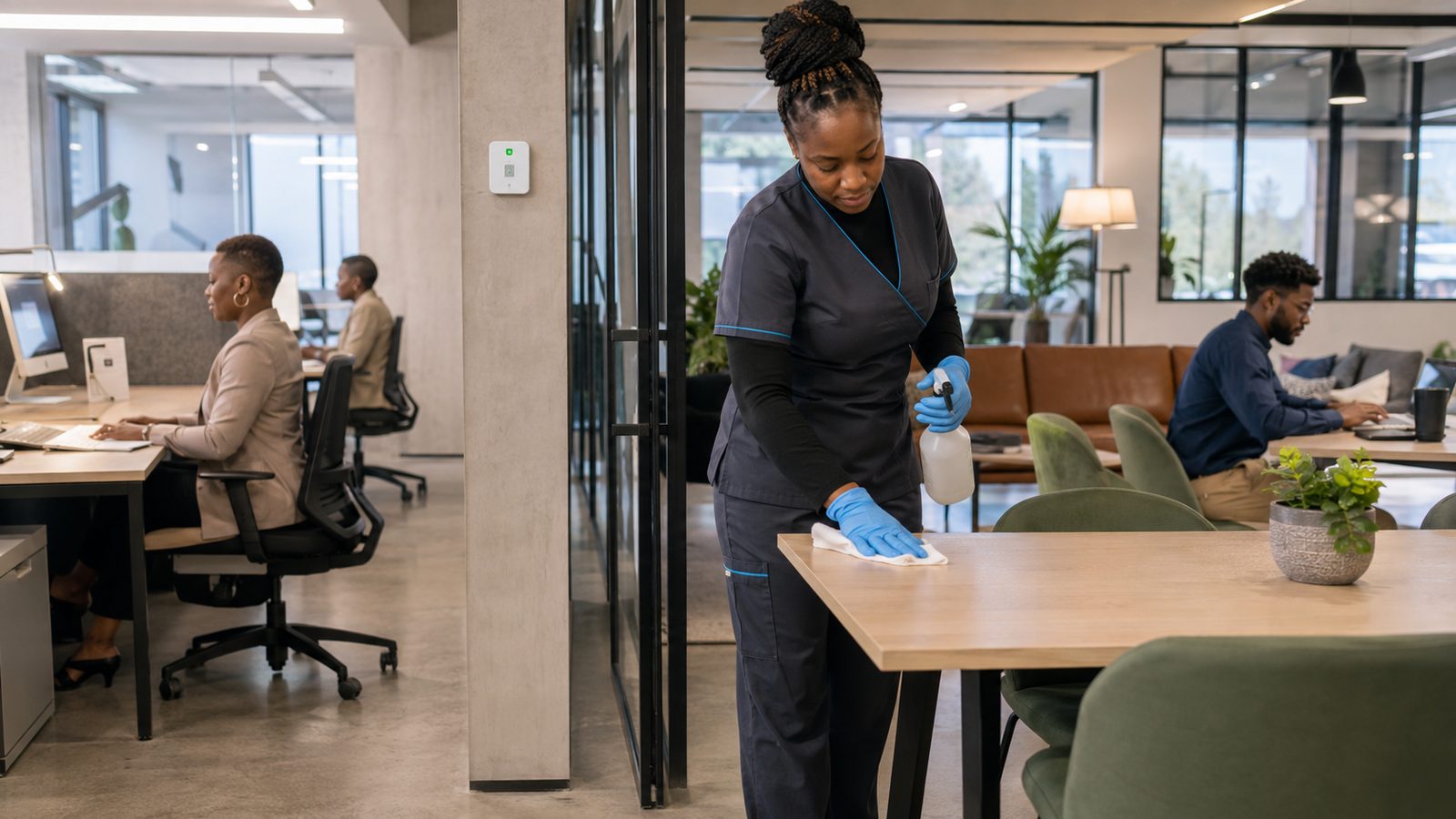
A tidy office and a hygienic office are not the same thing, and only one of them can be demonstrated.
The pandemic years changed how South African businesses talked about workplace hygiene. Several years on, a lot of offices have quietly drifted back to where they were before — surfaces that look fine, a cleaner who arrives after hours, and no way of establishing what was actually cleaned. Visible tidiness is doing the work that a specification should be doing.
Not All Surfaces Deserve the Same Treatment
The most useful change most offices can make costs nothing: stop treating every surface as one category. A workable specification tiers them.
| Tier | Examples | Treatment |
|---|---|---|
| Critical touch points | Door handles and push plates, light switches, lift buttons, shared printer screens, kettle and fridge handles | Disinfected every cleaning cycle |
| Standard surfaces | Desks and workstations, kitchen counters, bathroom fixtures | Cleaned and disinfected daily |
| Periodic targets | Upholstered furniture, carpets, air-conditioning vents and filters | Weekly to monthly, by written schedule |
The reason this matters is simple: a cleaner working without tiers will spend the same amount of attention on a boardroom table nobody touched as on the lift button everyone did. Tiering redirects effort to where transmission actually happens without adding hours.
Air Quality Is the Part Nobody Looks At
Surface cleaning is visible, so it gets attention. Air handling is invisible, so it does not — and in this metro, where airborne dust and coastal humidity are both live factors, that is the wrong way round.
A cleaning or facilities specification should address filter replacement on an observed schedule rather than a calendar one, coil cleaning to prevent mould establishing in the unit, and periodic inspection of ducting in older buildings. If your air-conditioning is recirculating dust that then settles on every surface, no amount of desk wiping fixes the underlying loop.
Know What Is in the Bottle
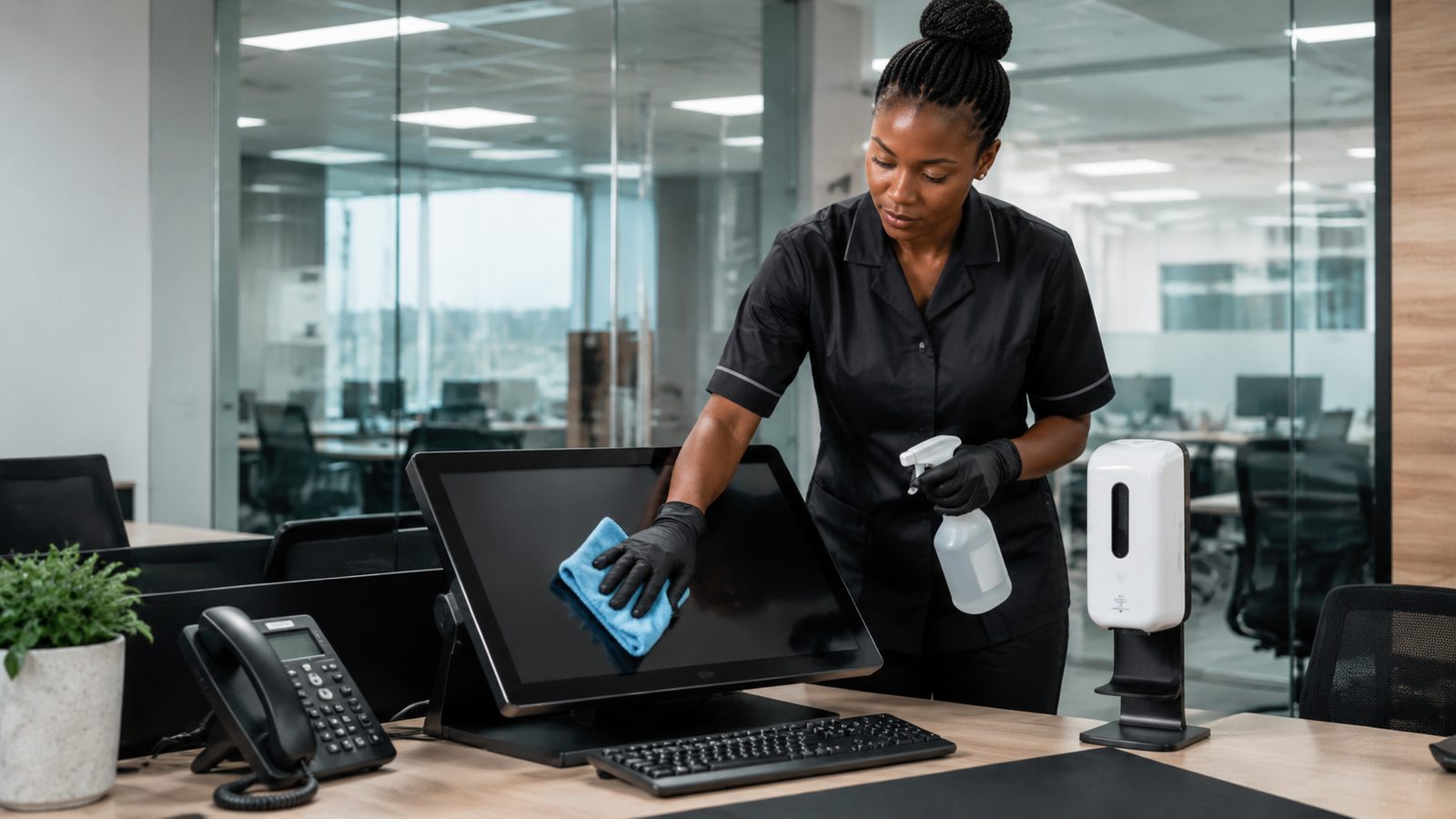
Every cleaning product used on your premises should have a current safety data sheet available to you, and your contractor should be able to tell you the dilution being used and why. This is partly a safety matter — your staff are in the room — and partly a straightforward competence test.
A contractor who cannot tell you what is being sprayed on the desk where someone eats lunch has either not trained their staff or is not tracking what they buy. Both are informative.
On disinfectant claims
Product marketing in this category is aggressive and the claims are not always comparable. What we will say plainly: dwell time is what makes a disinfectant work, and most surfaces in most offices are wiped long before the stated dwell time has elapsed. If you take one thing from this section, make it that — the product is rarely the limiting factor, the method is.
The Standard Worth Holding
“Clean” is not a standard because it cannot be checked. What can be checked is:
- A written schedule listing tasks against frequencies, by area
- Signed and timed records of completion, held on site rather than at the contractor’s office
- Defined touch-point coverage, so both parties know which surfaces are in the critical tier
- A joint inspection at a stated interval, scored against the schedule
- Verification testing where the risk justifies it — surface hygiene testing is available and is worth considering in food handling, healthcare-adjacent and high-density environments
Anything short of that is tidying, which is a legitimate service but should not be confused with hygiene management or relied on in an audit.
Where Offices Most Often Fall Short
- One cloth used across multiple areas, which moves contamination rather than removing it — colour-coded systems exist precisely to prevent this
- Disinfectant wiped off before it has had time to act
- Kitchen and tea point treated as a low-priority area despite being the highest-density shared-contact space in most offices
- Air-conditioning excluded from the cleaning scope entirely and forgotten by facilities
- No record of what was done, so a slip in standards is only detected once it is visible
The Bottom Line
Modern office hygiene is documented, risk-based and verifiable. Tier your surfaces, put the air handling inside someone’s scope, know what is in the bottle, and keep records that would satisfy a person who was not there.
Want cleaning you can verify rather than assume?
We work to written schedules with signed records and defined touch-point coverage.
Request a Written Scope Or call 079 096 3267