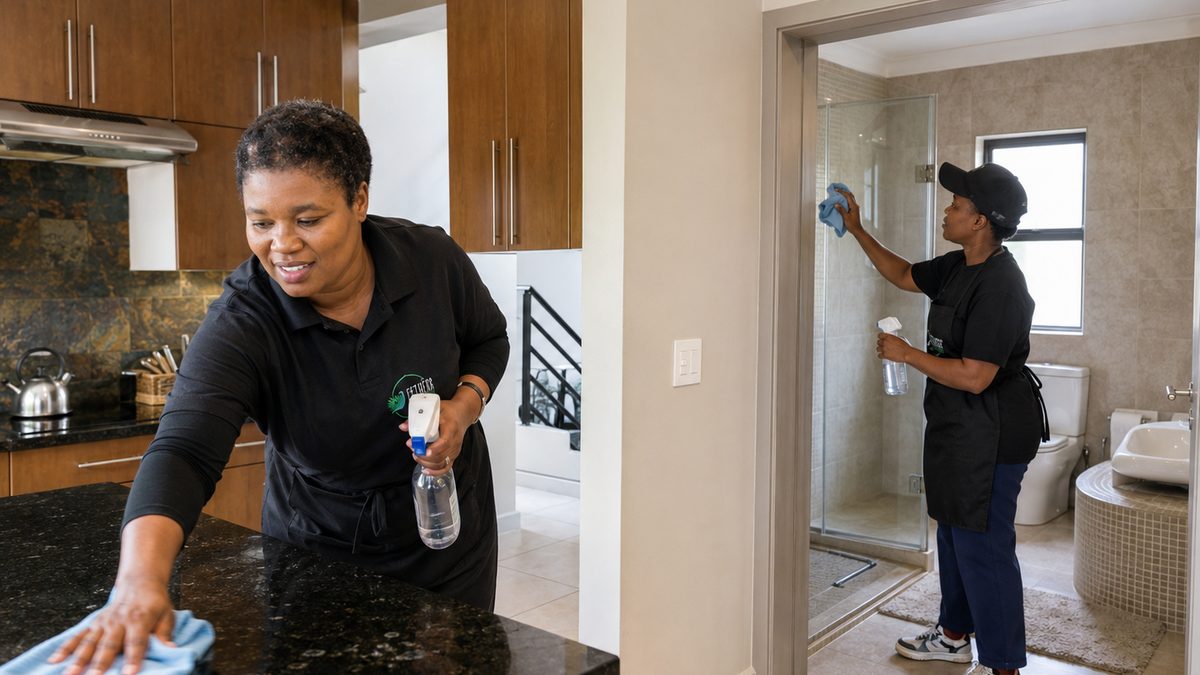
Seven honest indicators that professional help would make a real difference at home.
Hiring help at home carries a strange amount of baggage. People treat it as an admission that they are not coping, or as an indulgence they have not earned. It is neither. It is a decision about where your limited hours go — the same decision you already make when you take your car to a mechanic instead of servicing it yourself.
Here are seven honest signs that professional cleaning would make a real difference, and an equally honest section on when it would not.
1. You Are Never Actually Finished
There is a specific pattern worth recognising. You clean on a Saturday, you feel briefly on top of it, and by Wednesday the house has drifted back. You are not behind because you are lazy — you are behind because the work generated each week exceeds the hours you have available for it.
The tell is that catching up requires a whole weekend, and that catching up never quite happens. If cleaning has become something you are permanently in arrears on rather than something you complete, the arithmetic is not working.
That is a capacity problem, and no amount of better scheduling fixes a capacity problem.
2. Cleaning Is Consuming Time You Genuinely Do Not Have
Do the sum honestly. Count the hours per week that actually go into cleaning — including the mental time spent thinking about it and the weekend hours it consumes.
For most households running a full week, it lands somewhere between four and ten hours. That is a substantial portion of the discretionary time available in a week, spent on work that can be outsourced.
The question is not "can I afford a cleaner." It is "what is a Saturday morning worth to me, and what would I do with it instead." For some people the honest answer is that they would rather have the money. That is a legitimate answer. But it should be an actual decision rather than a default.
3. Certain Jobs Have Simply Stopped Happening
Every household has a list of tasks that have quietly fallen off the rotation. Common candidates:
- Windows, inside and out
- Behind and under the fridge, oven and washing machine
- Skirtings and door frames
- Inside kitchen cupboards
- Light fittings and ceiling fans
- Under beds and behind wardrobes
- The oven interior
- Curtains, blinds and window tracks
These are the tasks that get deferred first because nothing immediately goes wrong when they are skipped. But the deferral is not free. Grime that sits for a year is harder to remove than grime that sits for a month, and some of it — grease on cupboard doors, soap scum in a shower, staining in grout — eventually stops coming off at all.
If your honest answer to "when was that last done?" is "I am not sure," that is the sign.
4. The House Is Causing Friction
Housework is one of the most common sources of ongoing domestic conflict, and the argument is rarely actually about cleaning. It is about fairness, about who notices what needs doing, and about the invisible mental load of tracking it all.
Outsourcing does not resolve every dimension of that, and it would be dishonest to claim it does. But it does remove the recurring flashpoint. For a lot of households, the value of professional cleaning is measured less in clean floors and more in an argument that no longer happens every second week.
5. Your Circumstances Have Changed
Some periods genuinely exceed what a household can absorb. If you are in one of them, this is a temporary intervention, not a permanent lifestyle change:
- A new baby, or a second one
- Caring for an elderly parent or a family member who is unwell
- Recovering from surgery, injury or illness
- A demanding period at work — a project, a new role, exam season
- Bereavement
- Moving house, in either direction
- Renovation, which generates dust for weeks after the builders leave
There is no requirement to sign up indefinitely. Several months of help through a difficult stretch is a perfectly reasonable way to use the service, and it is a common one.
6. Physical Limitations Make Certain Tasks Unwise
Some cleaning tasks involve genuine physical risk, and the risk rises with age, mobility limitation or recovery from injury.
The tasks worth handing over regardless of everything else on this list:
- Anything requiring a ladder or step stool — windows, light fittings, high shelves, ceiling fans
- Moving heavy furniture and appliances
- Bath and shower cleaning, which involves awkward positions and wet surfaces
- Floor work requiring sustained kneeling
- Anything involving overhead reaching for extended periods
A fall at home is a serious event with lasting consequences. If a task involves climbing on something, it is worth outsourcing on that basis alone.
7. Your Home Is Working Against Your Health
Dust, pet dander and mould accumulate in specific, predictable places, and they matter more for some households than others.
Worth considering if anyone in the home has respiratory sensitivity or allergies:
- Carpets and rugs, which hold considerably more than hard flooring
- Upholstery and mattresses
- Curtains and soft furnishings
- Bathroom grout and sealant, where mould establishes early
- Behind and beneath furniture where dust sits undisturbed
- Air-conditioning filters and ceiling fan blades
An honest limit on this point
We are not going to claim professional cleaning treats or resolves any health condition, and you should be sceptical of any cleaning company that does. What is straightforwardly true: dust, dander and mould accumulate in the places listed above, and removing them thoroughly and regularly is a reasonable thing to do in a household where someone is sensitive to them. Medical questions belong with a medical professional.
Local Factors in Gqeberha
Two conditions specific to Nelson Mandela Bay increase the cleaning load on a home here compared with many inland areas.
Industrial dust deposition. Fine, dark, abrasive dust settles on windowsills, patio furniture, paving and outdoor fabrics far faster than ordinary household dust, and it stains once it becomes damp. Dry-wiping it grinds it into finishes and re-suspends the rest. Our guide to manganese dust in Port Elizabeth covers what actually removes it.
Coastal humidity and salt air. Humidity supports mould in bathrooms, behind furniture on external walls and around window reveals. Salt accelerates corrosion on burglar bars, security gates, window frames and outdoor furniture.
If you have concluded that you are simply not keeping up, part of the explanation may be that your home genuinely generates more work than the same house would elsewhere.
When Hiring a Cleaner Is Not the Answer
In fairness, this decision is not right for everyone, and there are situations where it will not deliver what people hope.
- Clutter is the real problem. Cleaning and decluttering are different tasks. A cleaner works around possessions; they do not sort them. If the underlying issue is volume of stuff, cleaning will not resolve it and may frustrate you.
- The budget is genuinely tight. If it means real financial strain, it is not worth it. A reduced scope — a fortnightly house cleaning visit, or a periodic deep clean only — is often a better fit than committing to weekly.
- You actually find it satisfying. Some people do, and there is no reason to outsource something you value doing.
- You are not comfortable with someone in your home. This is a legitimate consideration and worth being honest with yourself about.
- You need occasional help, not ongoing. A periodic deep clean two or three times a year may serve you better than a recurring schedule.
What to Ask Before You Book Anyone
- Are your cleaners your employees, and are they registered for UIF and covered under COIDA?
- Do you carry public liability insurance, and can I see proof?
- Is it the same person or team each visit?
- What exactly is included, and what costs extra? Ask specifically about windows, oven interior, inside cupboards and behind appliances.
- Do you supply products and equipment, or do I?
- How long is a standard visit?
- What happens if something is damaged?
- What is your cancellation and notice policy?
- Can I meet the person before the first visit?
The insurance and registration questions matter more than people realise. If someone is injured while cleaning your home and they are not properly registered or covered, the liability position can fall on you.
Starting Small Is Fine
You do not have to commit to a weekly schedule to find out whether this works for you. Reasonable starting points:
- One deep clean to reset the house, then reassess
- Fortnightly rather than weekly, which suits a lot of households better than they expect
- A specific scope — bathrooms and kitchen only, or the tasks you genuinely cannot face
- Seasonal only — two or three visits a year for the jobs that never happen
The Bottom Line
The clearest signs are structural rather than emotional: you are permanently in arrears rather than occasionally behind, whole categories of task have silently dropped off the list, the workload is consuming hours you would rather spend elsewhere, or certain jobs now carry physical risk.
None of that reflects on how well you run your home. It reflects the arithmetic of how many hours a week contains.
Feathers Cleaning and Hygiene provides residential cleaning across Gqeberha, East London, Mthatha and the wider Eastern Cape, with scopes matched to what each home actually needs.
Want this handled properly?
Tell us what you need cleaned and we will come and look at it before quoting anything.
Request a Written Scope Or call 079 096 3267