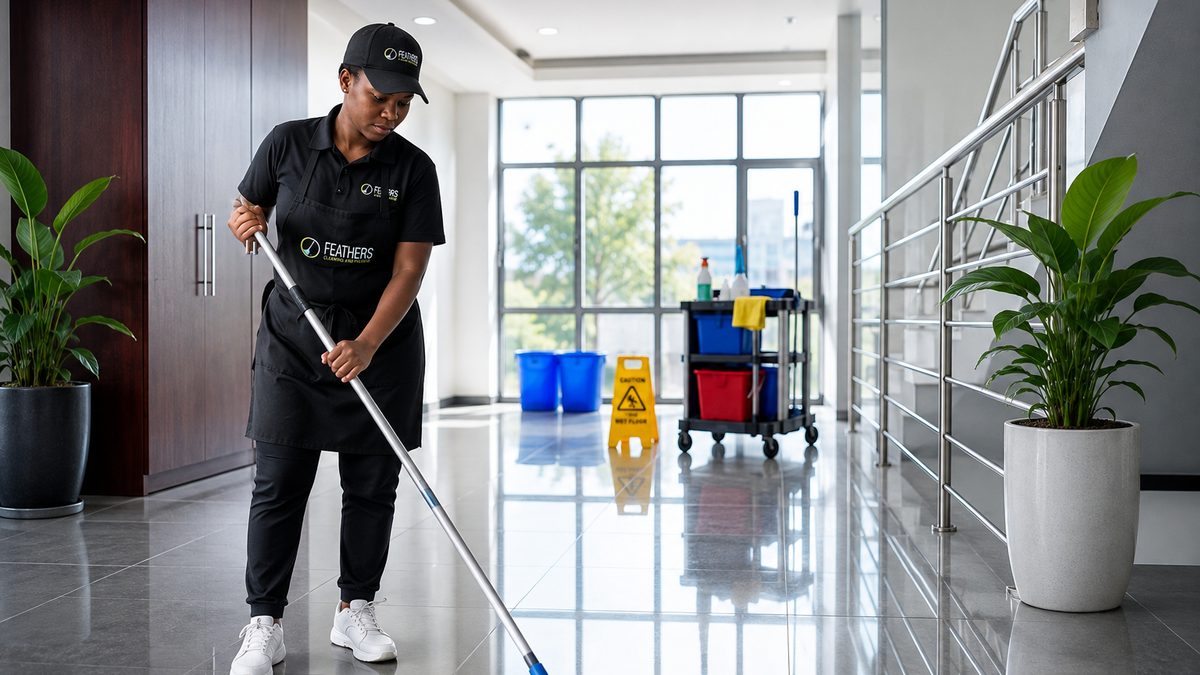
Deferred cleaning does not save money, it moves the cost.
Cleaning is one of the easiest line items to cut. It is visible on the budget, it has no immediate consequence when reduced, and nothing breaks the week after you scale it back. That combination makes it a favourite target during cost pressure — and it is why the true cost of neglected cleaning is almost never attributed to the decision that caused it.
Deferred cleaning does not save money. It converts a predictable, controllable operating cost into an unpredictable capital and productivity cost that surfaces somewhere else on the ledger, months later, where nobody connects it back.
Here is where it actually shows up.
1. Absence and Reduced Output
Shared workplaces concentrate contact, and hand-to-surface-to-hand transmission is the primary route. When high-touch points — door handles, keypads, shared equipment, kitchen taps — are not systematically disinfected, that route stays open.
The cost has two components, and the smaller one is the obvious one:
- Absence: salary paid for work not performed, plus disruption to whatever that person was responsible for
- Presenteeism: staff attending while unwell, working at reduced capacity, and infecting colleagues
Presenteeism is the larger cost and the harder one to see, because it never appears in an absence report. In South African workplaces, where sick leave entitlement is finite and attendance pressure is real, it is also extremely common.
Why we are not giving you a percentage
You will find articles claiming professional cleaning reduces absenteeism by a precise figure. The published research varies substantially by setting, baseline and methodology, and any single number quoted out of context would be misleading. What is well established and worth stating plainly: high-touch surfaces are a recognised transmission route in shared workplaces, and systematic disinfection interrupts it. Model your own exposure using your actual absence data rather than someone else's headline statistic.
2. Flooring — The Most Expensive Thing You Are Not Protecting
Flooring is usually the single largest replaceable asset in an office fit-out, and it is the one most directly damaged by inadequate cleaning.
Carpet
The damage mechanism is mechanical, not aesthetic. Grit and abrasive particulate tracked in from outside works down into the pile and sits at the base of the fibres. Every footfall then grinds those particles against the fibre, cutting it. By the time carpet looks worn, the fibre has been physically severed — and no amount of subsequent cleaning restores it.
Regular vacuuming with adequate suction removes that grit before it does structural damage. Periodic extraction removes what vacuuming cannot. Skip both, and you replace carpet years earlier than its rated life.
This matters more in Gqeberha than in many markets, because local industrial dust deposition means more abrasive particulate arrives at the door in the first place.
Hard flooring
Sealed and treated hard floors — vinyl, tile, polished concrete, timber — carry a protective layer that is designed to be sacrificial. It wears; you maintain and reapply it. Once it wears through, damage reaches the substrate, and you are no longer maintaining a floor, you are replacing one.
The cost differential between scheduled maintenance and reactive replacement is substantial, and entirely avoidable.
3. HVAC Load and Energy Draw
Air-conditioning filters loaded with dust force the system to work harder to move the same volume of air. That has three consequences: higher energy consumption, shortened component life, and reduced cooling performance in a climate where cooling is not optional.
In Gqeberha the loading rate is higher than generic service schedules assume, because of local dust deposition. Businesses following the manufacturer's default interval are routinely running loaded filters for weeks before replacement.
The associated costs:
- Elevated electricity consumption across the whole cooling season
- Earlier compressor and fan motor failure
- Emergency callout rates instead of scheduled servicing
- Reduced indoor air quality, which loops back into cost item one
4. Equipment and IT
Dust accumulation in cooling fins, fan housings and vents reduces heat dissipation. Electronics running hotter fail sooner. This applies to desktop machines, network equipment, printers and — most expensively — anything in a server room or comms cabinet.
Server rooms are particularly exposed because they are frequently excluded from the standard cleaning scope, either for access reasons or because nobody specified them. The result is the highest-value equipment in the building sitting in the least-maintained room.
5. Building Fabric and Finishes
| Element | What Neglect Causes | Cost When It Surfaces |
|---|---|---|
| Glazing | Micro-scratching from dry-wiping abrasive dust; permanent haze | Panel replacement |
| Painted and rendered walls | Dust staining, particularly around vents and high-traffic corridors | Early repaint cycle |
| Upholstery | Soiling becomes permanent staining once it sets | Reupholstery or replacement |
| Grout and sealant | Mould establishment; sealant degradation | Regrouting; water damage remediation |
| Metal fixtures | Salt-air corrosion accelerated by deposited particulate | Replacement of gates, frames, fittings |
| Sanitaryware | Scale and staining bonding to the surface | Fixture replacement |
Every one of these is a capital cost created by the absence of an operating cost.
6. Pest Pressure
Pests need food, water and harbourage. Inadequate kitchen cleaning, poorly managed waste and uncleaned areas behind and beneath fixed furniture supply all three.
The costs stack quickly:
- Pest control treatment, which is reactive and priced accordingly
- Follow-up treatments, because a single treatment rarely resolves an established problem
- Product or stock loss where relevant
- Reputational damage if a client or staff member witnesses activity
- Potential regulatory exposure in food-handling or healthcare-adjacent premises
Prevention here is straightforwardly cheaper than response, and the prevention is simply competent routine cleaning.
7. Staff Retention
Nobody resigns solely because the bathrooms are poorly maintained. But premises condition is a persistent, daily signal about how an employer regards its staff, and it accumulates alongside every other factor in a retention decision.
The elements that register most:
- Bathroom condition and restocking reliability
- Kitchen and break area state
- Air quality and temperature
- Whether reported issues actually get fixed
Replacing a staff member carries recruitment cost, onboarding time, productivity ramp and the loss of institutional knowledge. Against that, the marginal cost of maintaining bathrooms and break areas properly is small.
8. Lost Business and Client Perception
Clients, suppliers and prospective employees form a judgement about your operation from your premises, usually within the first minute of arrival. In the Eastern Cape, where business runs substantially on relationships and referral, that judgement travels.
The specific signals: entrance glazing, reception flooring condition, seating area cleanliness, bathroom standards and odour. None of these require refurbishment. They require consistent cleaning to a defined standard.
This cost is impossible to quantify because you never learn about the deal you did not get. That does not make it zero.
9. Compliance, Liability and Insurance
Employers carry obligations around workplace hygiene, safe access and ablution facilities, and increasingly the obligation to demonstrate compliance rather than merely assert it.
Exposure points when cleaning is informal or undocumented:
- No cleaning records to produce during an inspection or incident investigation
- Slip and fall incidents where no maintenance record exists to demonstrate reasonable care
- Chemical storage without safety data sheets or correct labelling
- Uninsured cleaning staff working on site, transferring liability to you
- Insurance claims complicated by an inability to demonstrate maintenance
These costs are low-probability and high-severity. They are also entirely avoidable through documentation that a competent contractor produces as a matter of routine.
How to Build Your Own Cost Comparison
Rather than accepting anyone's headline figures — ours included — build the comparison from your own numbers.
Step 1: Total your current true cost
- Cleaning wages plus statutory contributions
- Consumables and chemical purchases over twelve months
- Equipment purchase, repair and replacement
- Management hours spent supervising, procuring and handling complaints, costed at that person's actual rate
- Cover arrangements during leave and absence
- Any periodic services bought in separately — carpet extraction, window cleaning, floor treatment
Step 2: Total your deferred-cost exposure
- Current age and expected remaining life of flooring, against its rated life
- HVAC service frequency and any unscheduled callouts in the last two years
- Pest control spend
- Repaint and refinishing intervals
- Absence data for the last twelve months
Step 3: Get a properly scoped quote
Insist that any quote states every task with its frequency, the hours on site, what consumables are included, which periodic services are in or out, and who supervises. A monthly figure with no scope is not comparable to anything.
Where Cutting Cleaning Is Defensible
In fairness, there are situations where reducing cleaning spend is a reasonable call:
- Genuinely over-specified frequencies — a low-occupancy office cleaned daily may be well served by three days a week
- Duplicated services — periodic tasks being bought both within a contract and separately
- Reduced occupancy — hybrid working genuinely changes requirement, and specifications often lag behind
- Areas genuinely out of use — a mothballed floor does not need a full schedule
The distinction that matters: reducing frequency where demand has genuinely fallen is optimisation. Reducing scope so that high-touch disinfection, bathrooms or periodic floor maintenance stop happening is deferral, and deferral has a bill attached.
The Bottom Line
Cleaning is a maintenance function, not a cosmetic one. Cut it, and the money does not disappear from the business — it reappears as early flooring replacement, elevated energy draw, equipment failure, pest treatment, absence, turnover and, occasionally, a compliance problem you cannot document your way out of.
The correct question is not "how little can we spend on cleaning." It is "what specification protects the assets and the people, and what does that actually cost." Those are very different exercises, and only one of them produces a number you can defend.
Feathers Cleaning and Hygiene provides written, costed scopes for commercial premises across Gqeberha, East London, Mthatha and the wider Eastern Cape.
Want this handled properly?
Tell us what you need cleaned and we will come and look at it before quoting anything.
Request a Written Scope Or call 079 096 3267