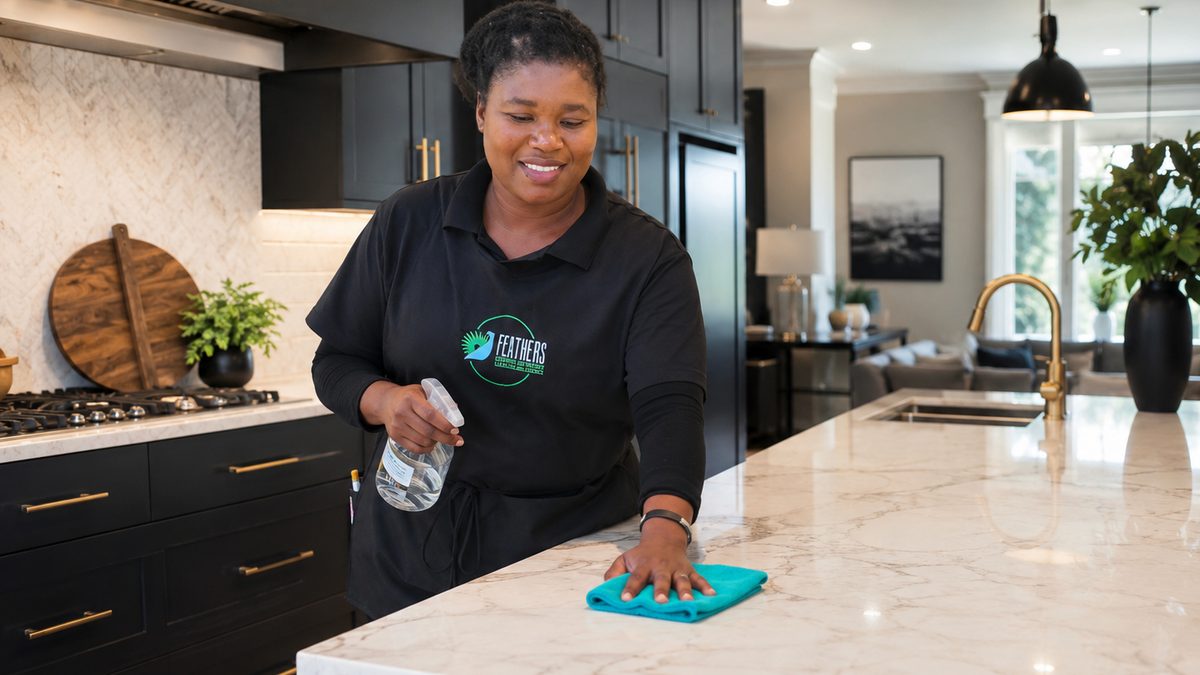
Equipment, chemical control, training, compliance and pricing all differ.
People often assume commercial cleaning is simply residential cleaning applied to a bigger space. It is not. The two are different disciplines with different equipment, different chemical regimes, different training requirements, different compliance obligations and different commercial models. Hiring the wrong one for your property produces predictable problems — usually underperformance in one direction, or unnecessary cost in the other.
Here is what actually separates them, and how to work out which you need.
The Core Distinction
Residential cleaning is oriented around a household's standards. It is personal, flexible, negotiated directly with the occupant, and success is judged by whether the home feels clean to the people who live in it.
Commercial cleaning is oriented around a defined specification. It exists to maintain a stated standard across a shared space used by people who did not choose the cleaning arrangement, with obligations to staff, visitors, insurers and regulators layered on top. Success is judged against a written scope.
That difference in orientation drives everything else.
1. Scale and Method
Scale is not simply "more square metres." It changes the correct method.
- Residential: a domestic vacuum, mop and bucket, and cloths are appropriate to the surface area involved. Working room by room is efficient.
- Commercial: the same approach across 800 square metres of office floor would take a full day and produce inconsistent results. Commercial work uses machines — scrubber-driers, rotary machines, wide-area vacuums — and works in systematic passes rather than room by room.
Beyond a certain floor area, machine methods are not a luxury. They are the only way to achieve a consistent result in a workable timeframe.
2. Equipment
| Equipment | Residential | Commercial |
|---|---|---|
| Vacuum | Domestic upright or cylinder | Commercial vacuum with filtration; backpack units for productivity |
| Floors | Mop and bucket | Scrubber-drier, rotary machine, buffer, burnisher |
| Carpet | Occasional hired machine | Hot water extraction unit; encapsulation systems |
| Windows | Cloth and squeegee at ground level | Water-fed pole systems; access equipment; height procedure |
| Cloth system | Whatever is to hand | Colour-coded microfibre system by zone |
| Chemicals | Retail products, ready to use | Concentrates, dosed via dilution control, with safety data sheets |
The colour-coding point
Commercial cleaning uses colour-coded cloths and mops separating bathroom, kitchen, general surface and glass. The purpose is to make cross-contamination physically impossible rather than dependent on someone remembering which cloth was used where. In a household, one person cleaning their own bathroom and kitchen carries a different risk profile. In a shared workplace, it is a hygiene control — and any commercial contractor who cannot explain their system on the spot is telling you something about their training.
3. Chemicals and Dilution Control
Residential cleaning largely uses ready-to-use retail products. Commercial cleaning uses concentrates dosed through dilution equipment, for three reasons: cost per use, consistency, and control.
Consistency matters more than people expect. A disinfectant mixed too weak does not work; mixed too strong it wastes product and can leave residue that attracts soiling. Dilution control removes that variable from the individual cleaner's judgement.
Commercial operations also carry documentation obligations that domestic ones do not — safety data sheets on site, correct labelling of decanted product, and appropriate storage.
4. Training and Supervision
Residential cleaning skill is largely built through experience. Commercial cleaning requires trained method, because the consequences of error are larger and the substrates more varied.
A commercial cleaner needs to know:
- Which chemical is safe on which substrate — acidic products will etch natural stone; solvents will damage powder coating
- Correct dwell times for disinfectants
- Safe use of floor machines, including chemical and pad selection
- Working-at-height procedure where applicable
- Colour-coding discipline
- Signage, wet floor management and public safety
- Handling of confidential material and secure areas
Commercial work is also supervised. A named supervisor attends site, audits against the scope and is accountable for the standard. Residential arrangements are typically direct between householder and cleaner, with the householder doing their own quality control.
5. Scheduling and Access
- Residential: generally during the day, arranged around the household. Access via a key or the occupant being present.
- Commercial: frequently after hours, early morning or overnight, to avoid disrupting operations. This brings alarm codes, key control, security escorts, out-of-hours building access and lone-working considerations.
Continuity of cover is also structural rather than optional. If a residential cleaner is ill, the clean is postponed. If a commercial contractor's staff member is ill, the contractor must still deliver the scope — cover is part of what you are buying.
6. Compliance and Documentation
This is the largest practical difference, and the one most often overlooked when businesses engage informal cleaning arrangements.
A commercial contractor should be able to produce:
- COIDA registration for their staff
- UIF compliance
- Valid tax clearance
- Public liability insurance
- Safety data sheets for every chemical used on your site
- A documented cleaning schedule with recorded completion
- Evidence of staff induction and training
These are not administrative formalities. If an incident occurs on your premises involving an uninsured, unregistered cleaner, the liability position is materially worse for you. The gap only becomes visible at the moment it matters.
7. How Pricing Works
The commercial models are genuinely different, which is why direct price comparison between the two is meaningless.
| Residential | Commercial | |
|---|---|---|
| Basis | Per visit or hourly | Monthly contract against a written scope |
| Scope | Often informal or verbal | Written, task-by-task, with frequencies |
| Consumables | Usually supplied by householder | Often included or separately managed |
| Periodic work | Ad hoc when requested | Scheduled into the contract or quoted separately |
| Term | No commitment | Contract term with a notice period |
| Quality control | Householder inspects | Supervisor audits against scope |
Which Do You Actually Need?
The dividing line is not building type. It is whether the space is shared, occupied by people other than the owner, and subject to obligations to those people.
You need commercial cleaning if:
- Staff, customers or the public use the space
- You have obligations under occupational health and safety legislation
- You need documented cleaning records
- The floor area requires machine methods
- You need guaranteed cover regardless of individual availability
- You have industrial, medical, food-handling or regulated activity on site
- Insurance or lease terms require evidence of maintenance
Residential cleaning is right if:
- It is a private home occupied by the household
- The scale is manageable with domestic equipment
- There is no third-party obligation or compliance requirement
- Flexibility matters more than documented consistency
The genuine grey areas
- Home offices with visiting clients — usually residential, but client-facing areas may warrant a commercial standard
- Short-term rental and guest accommodation — domestic in scale, commercial in obligation; turnaround cleaning is its own discipline
- Small professional practices in converted houses — commercial obligations, residential scale. Usually commercial is correct, but scoped modestly
- Body corporate common areas — commercial, even though the units are residential
- Very small offices, two or three people — genuinely borderline. A simple internal arrangement may serve, provided bathrooms and compliance are addressed
An honest note
We provide both commercial and residential cleaning, so we have no incentive to push you toward the larger contract. If your property genuinely sits on the residential side of the line, that is what we will tell you — and it will cost you less. The wrong service is a bad outcome for both of us.
What Both Have in Common
Worth stating, because the differences can obscure it. Both disciplines depend on the same fundamentals:
- Correct chemical for the substrate — the most common cause of avoidable damage in either setting
- Working top down, so you do not clean the same surface twice
- Removing soil rather than redistributing it
- Consistency over intensity — regular competent cleaning beats occasional heroic effort
- Trained method preventing damage as much as delivering cleanliness
The Bottom Line
Commercial cleaning is not residential cleaning at scale. It differs in equipment, chemical control, training, supervision, access arrangements, compliance obligations and commercial structure — and those differences exist because the space is shared, the obligations are broader and the standard has to be demonstrable rather than merely felt.
Work out which side of the line your property sits on by asking whether the space is shared, whether third parties use it, and whether you need to be able to evidence maintenance. Those three questions resolve most cases.
Feathers Cleaning and Hygiene provides both commercial and residential cleaning across Gqeberha, East London, Mthatha and the wider Eastern Cape.
Want this handled properly?
Tell us what you need cleaned and we will come and look at it before quoting anything.
Request a Written Scope Or call 079 096 3267