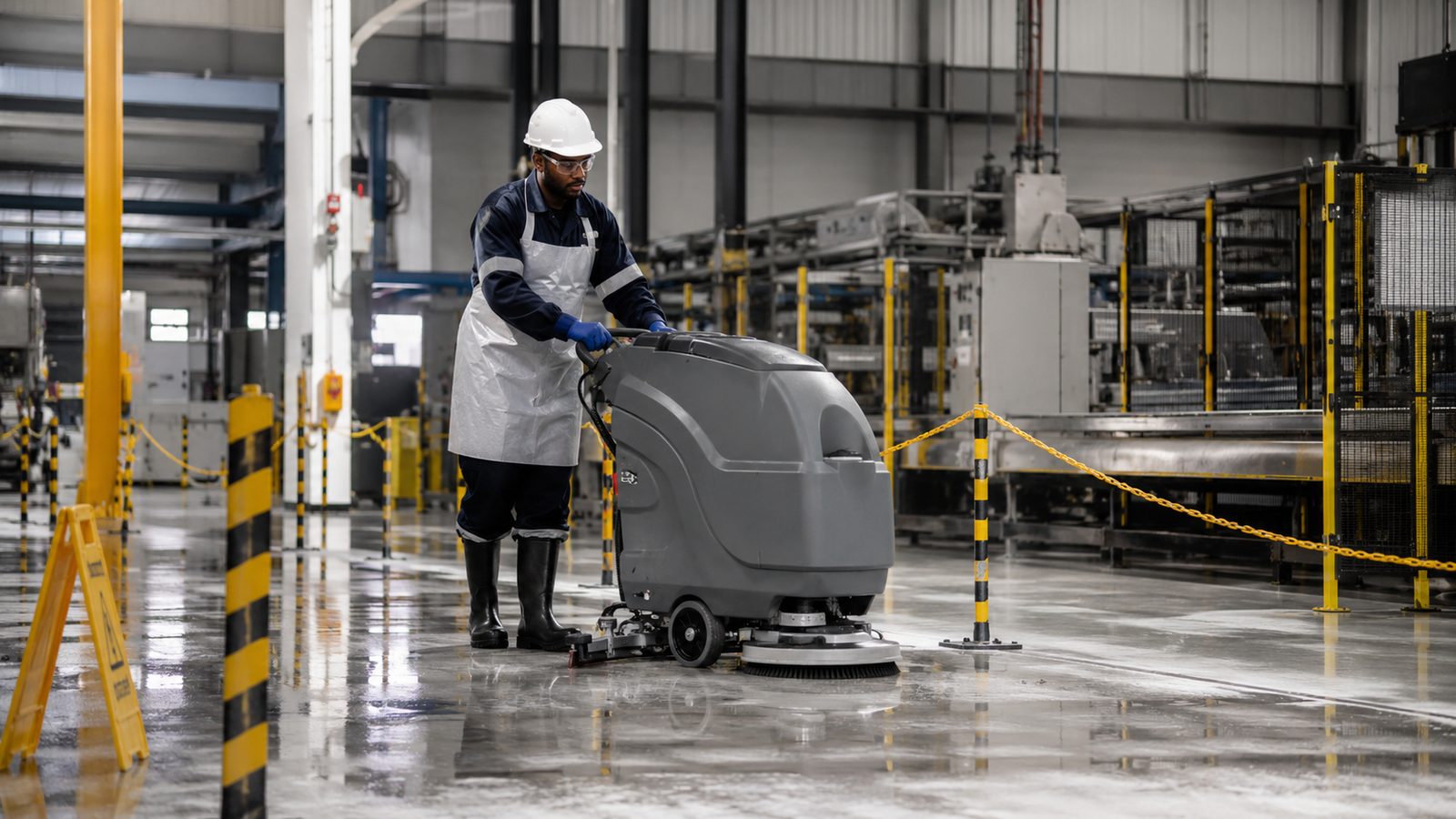
Manufacturing hygiene is a documentation exercise as much as a cleaning one, and the gap between the two is where enforcement finds you.
If you manage operations or facilities at a manufacturing site in the Eastern Cape, you already know that cleaning is not judged on appearance. It is judged on whether the programme is designed for the risk, executed consistently, and evidenced. Most sites that fail an audit are not dirty. They are undocumented.
Hygiene Standards Are a Management System, Not a Cleaning Manual
The South African standards that apply to manufacturing hygiene set out how the hygiene function should be managed rather than how to clean a specific machine. Broadly, they call for premises designed so that effective cleaning is possible, waste handling that prevents accumulation and pest attraction, a documented pest control programme, and cleaning schedules matched to the risk profile of each zone.
Confirm which standard applies to you
Different manufacturing sectors are held to different standards, and food production and pharmaceutical operations carry additional layers on top. Standards are also revised. We are not going to name a clause and a year in a blog post that will still be online long after the revision — confirm the applicable standard and its current edition with your certification body, your sector association or the South African Bureau of Standards. What follows works regardless of which one applies to you.
Zone-Based Cleaning
A factory floor is not uniform, and a single site-wide cleaning frequency is either wasteful in the low-risk areas or inadequate in the high-risk ones. Split the site.
| Zone | Typical requirement |
|---|---|
| Production | Daily deep clean with appropriate chemistry, colour-coded equipment to prevent cross-contamination, immediate spill response, scheduled equipment cleaning |
| Storage and warehousing | Weekly machine floor scrubbing, monthly racking and high-level dusting, scheduled pest inspection |
| Administration and canteen | Daily surface cleaning and sanitising, weekly deep clean of kitchen facilities, periodic carpet and upholstery extraction |
| External and yard | Frequency driven by local dust and salt exposure rather than a template |
Colour coding is the cheapest control on this list and the most frequently skipped. One cloth or one mop moving between a production zone and an ablution is a cross-contamination route that no chemical fixes.
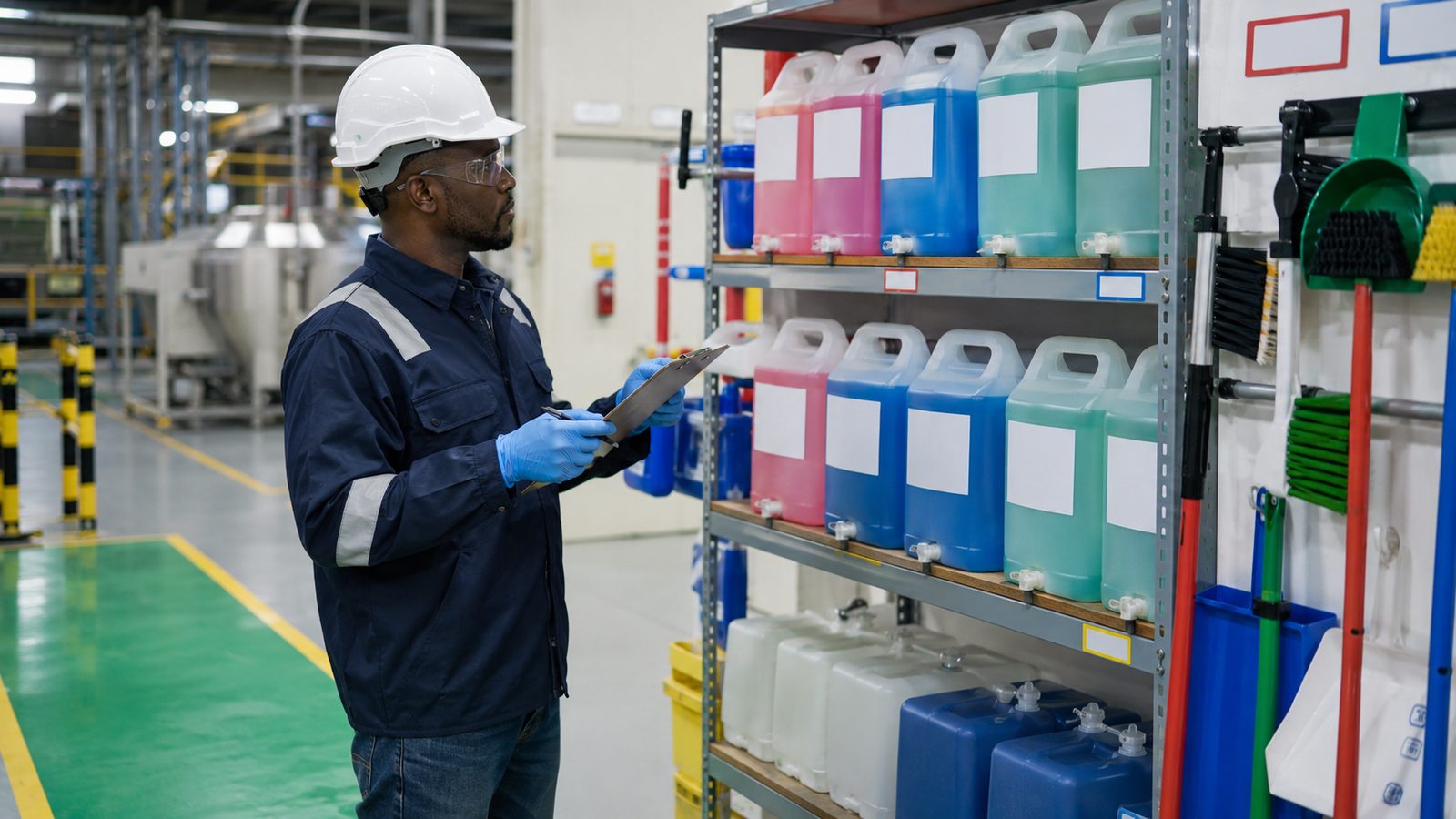
Chemical Documentation
Every chemical on your premises needs a current safety data sheet, and every person handling it needs documented training. This applies to the cleaning contractor’s chemicals as much as to your process chemicals, and an inspector will not distinguish between them.
Ask your contractor for:
- A chemical inventory with a current safety data sheet for every product used on site
- Dilution logs recording product, ratio, date, time and who prepared it
- Training records for chemical handling and personal protective equipment
- Spill kits appropriate to the products in use, and a written emergency response procedure
If those documents cannot be produced during an inspection, the exposure is not only the contractor’s. It is yours.
Planning for Power and Utility Interruptions
Unplanned stoppages create hygiene risks that a standard cleaning programme does not cover. Refrigeration warms, extraction and air handling stop, sump and drainage pumps stop. A contractor working on a manufacturing site should have a written contingency covering at minimum:
- Refrigerated storage failure — immediate cleaning and sanitising once supply returns, before restocking
- Air handling downtime — increased surface cleaning frequency while the system is off
- Drainage backup — manual pumping capability and a flood response
This is a short section of the scope and it is almost never written until the first incident.
Audit Yourself Quarterly
Do not let an external inspection be the first time anyone checks. A quarterly internal audit takes a morning and covers four things:
- Documentation. Safety data sheet file current, training records current, cleaning schedules signed off
- Visual inspection. Floor condition, waste accumulation, evidence of pest activity, drainage
- Equipment. Dosing systems calibrated, machinery serviced, personal protective equipment in usable condition
- People. Ask an operative to explain a chemical hazard and the spill procedure. If they cannot, the training record is a piece of paper rather than a fact
The fourth check is the one that predicts audit results
Documentation can be assembled in a week. Whether a cleaning operative on the floor can explain what they are using and what to do if it spills cannot. That is why inspectors ask, and it is the fastest read available on whether a cleaning programme is real.
The Bottom Line
Industrial cleaning is about product integrity, worker safety and regulatory position, not appearance. Zone the site, colour-code the equipment, document the chemistry, write the contingency, and audit yourself before anyone else does.
Feathers Cleaning and Hygiene builds industrial cleaning programmes for manufacturing and warehousing sites across Gqeberha, East London and the wider Eastern Cape, with the documentation set that goes with them.
Need a factory floor assessment?
We build zone-based industrial cleaning programmes with the documentation to match.
Request a Site Assessment Or call 079 096 3267