
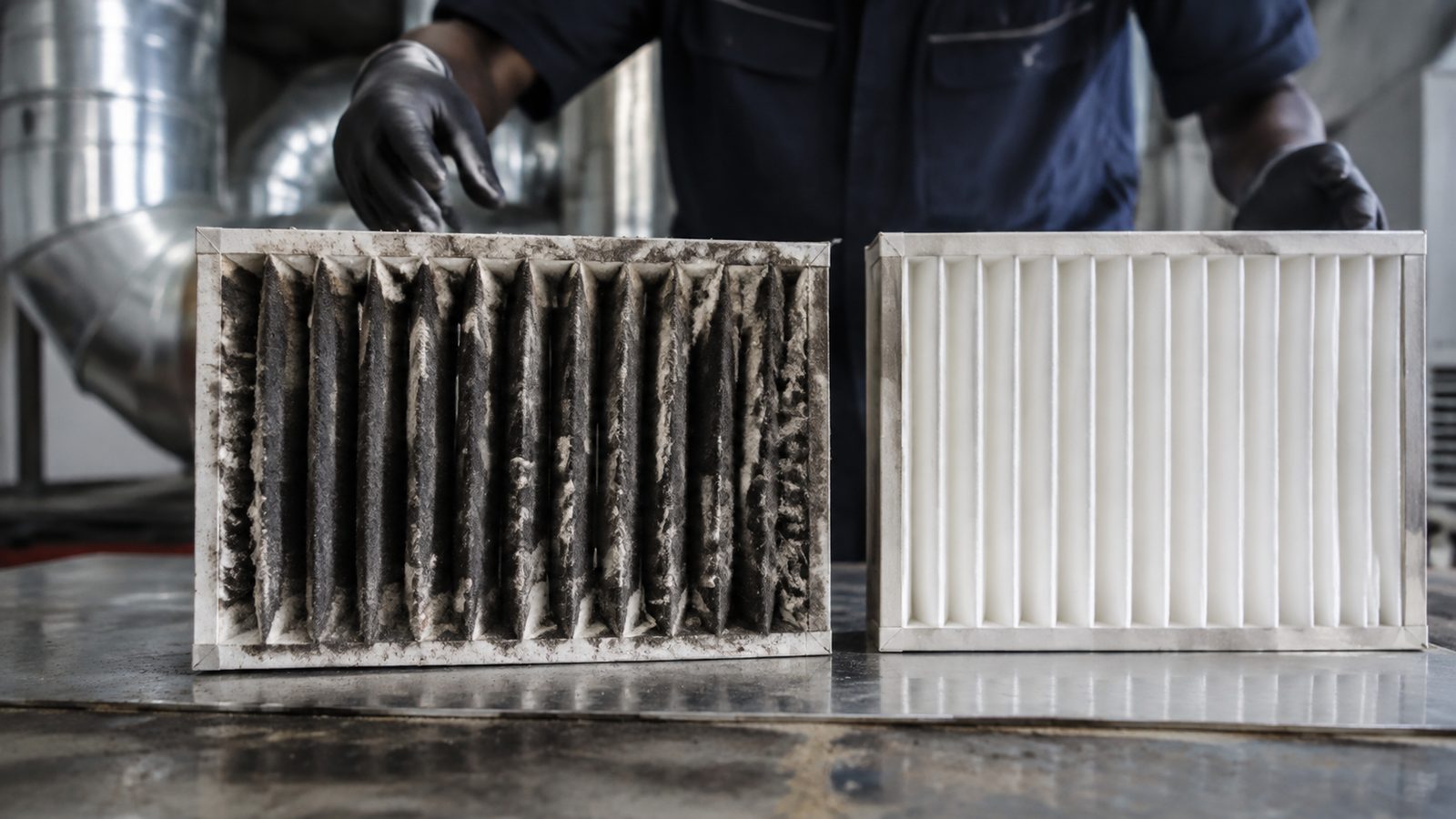
Filters in buildings near the harbour and the industrial corridors reach capacity well ahead of the interval printed on the box.
Manufacturer replacement intervals are written for a general environment. Significant parts of this metro are not a general environment. Bulk ore handling and port activity put fine abrasive particulate into the air, and every air-conditioning and air-handling unit in the vicinity is filtering it out of the air continuously.
What Happens When a Filter Loads Early
- Airflow drops. The unit moves less air through the space, so cooling and ventilation performance falls before anyone reports a fault.
- Energy use rises. The system works harder against the restriction to achieve the same result.
- Dust recirculates. A loaded or bypassed filter stops holding particulate, which then settles on desks, screens, stock and flooring — where it is mistaken for a cleaning failure.
- Components wear. Coils and fans running in a dust-laden airstream do not last as long as the maintenance schedule assumes.
The first three of those look like separate problems. They are one problem, and it is upstream of the cleaner.
Why Templated Schedules Under-Serve These Buildings
A cleaning or facilities schedule copied from a national template will treat filter attention as a quarterly or half-yearly item. In an affected corridor, filters may need attention at a fraction of that interval. Carpets and hard floors in the same buildings accumulate the same particulate faster, which turns ordinary foot traffic into a mild abrasive action on the floor finish.
None of this means the template was wrong. It means it was written for somewhere else.
A Practical Two-Part Response
- Shorten the cycle and write it into the scope. Filter attention and deep-clean intervals adjusted for the site, documented, so the cost is planned and visible rather than appearing as a reactive call-out.
- Change the surface method. Wet methods on hard surfaces and filtered extraction on carpets and upholstery, so the dust is removed from the building rather than lifted into the air to settle again.
Set the interval by inspection, not by the calendar
The only reliable way to fix a filter interval for a specific building is to inspect and record the condition over the first two or three cycles, then set the frequency to what the evidence shows. A contractor who cannot show you the difference in dust load between visits is not measuring anything.
Where Responsibility Usually Falls Between Two Parties
Filters are the classic orphan item. Facilities assumes the cleaning contractor handles them; the cleaning contractor assumes the air-conditioning service provider does; the air-conditioning provider attends twice a year on a maintenance contract written before the dust problem was understood. Nobody is at fault and nobody is doing it.
The fix is a line in one scope naming who inspects, who changes, at what interval, and who is told when a filter is loaded early. It does not much matter which party carries it, as long as one of them does.
What Not to Do
Increasing surface wiping while leaving the filtration unaddressed moves dirt around at additional cost. If the air handling is recirculating particulate, the surfaces will keep reappearing dusty regardless of how often they are cleaned, and the cleaning contractor will get the complaint for a problem sitting in the plant room.
The Bottom Line
In the affected parts of Gqeberha, filter loading is a cleaning issue, an energy issue and an equipment life issue at the same time. Adjust the interval to the building, document it in the scope, and make sure one named party owns it.
Filters clogging ahead of schedule?
We build dust-adjusted frequencies into scopes for properties in the affected corridors.
Request a Dust Assessment Or call 079 096 3267