
There is no universal answer to how often an office should be cleaned. There is a structure — and it stops the quiet areas quietly getting nothing.
Cleaning frequency is one of the few decisions in facilities management where both over-specifying and under-specifying cost real money. Too much and you are paying for hours the building does not need. Too little and carpets, floors and finishes wear out early while the standard drifts downward slowly enough that nobody logs a complaint until it is bad.
What Should Move Your Frequencies
- Foot traffic. The single biggest driver, and the reason reception and corridors need a different cycle from a private office.
- Sector. A medical suite, a food-handling business and a design studio have genuinely different requirements.
- Season. Wetter months bring more soil in on shoes; flu season warrants closer attention to shared surfaces.
- Shared equipment. Hot-desking and shared workstations raise the touch-point load considerably.
- Building and location. In Gqeberha, coastal exposure and airborne dust push external glazing and horizontal surfaces onto a shorter cycle than an inland template assumes.
Daily
Reception and meeting rooms
- Wipe desks, tables, door handles, light switches and chair arms
- Vacuum high-traffic carpet
- Empty bins and replace liners
Restrooms
- Clean and disinfect toilets, basins, taps and flush handles
- Restock soap, toilet paper and hand towel
- Empty sanitary bins where required
- Mop floors with disinfectant
Kitchens and breakrooms
- Disinfect counters, tables and appliance handles
- Remove food waste and wash the bin itself, not just change the liner
Workstations
- Empty bins
- Wipe shared surfaces and equipment
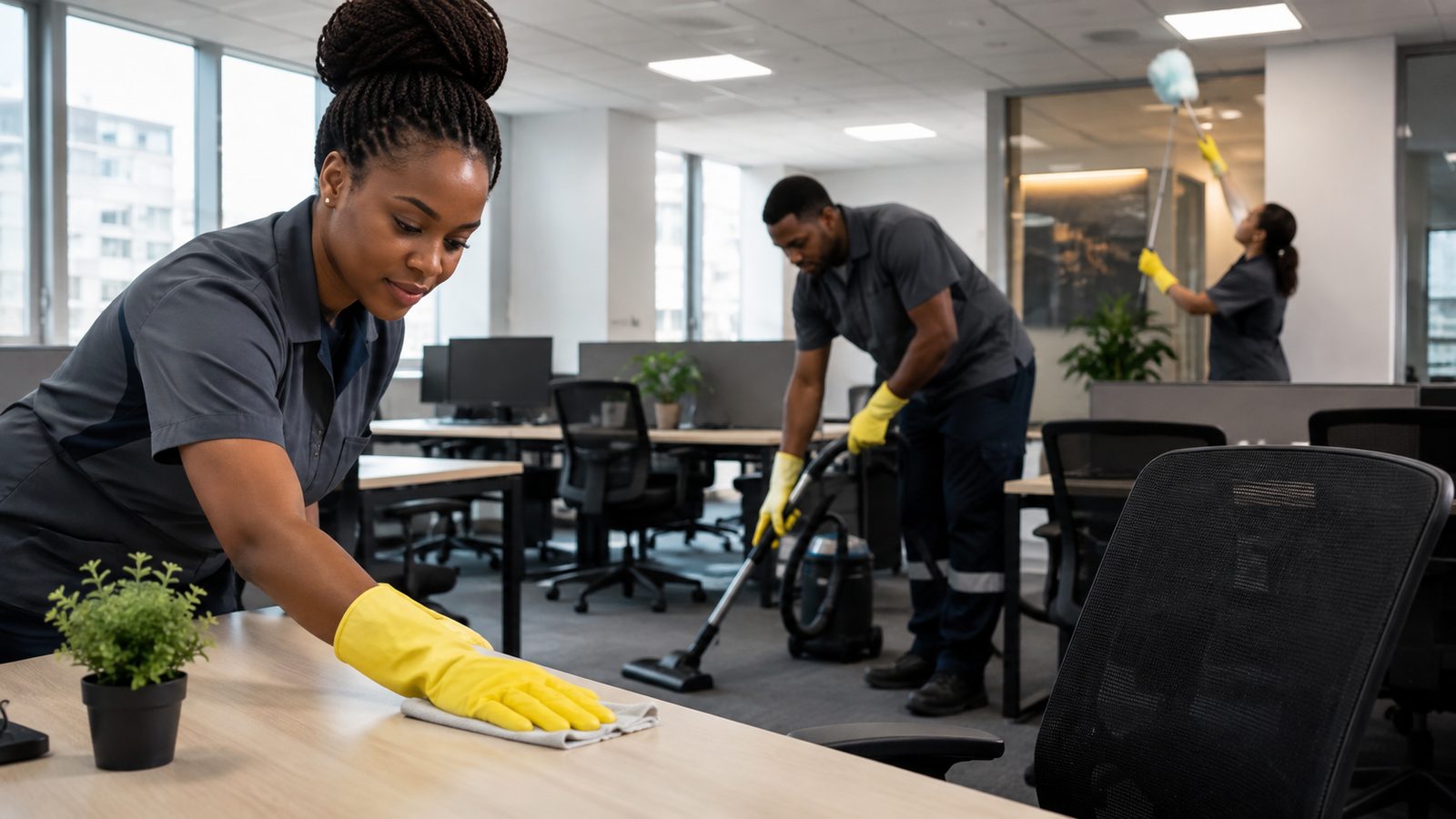
Weekly
- Deep clean restroom floors and walls
- Vacuum and mop all hard floors, edges included
- Dust surfaces, skirtings and windowsills
- Disinfect keyboards, mice and shared phones
- Clean internal glass doors and partitions
Monthly
- Machine scrub or buff hard floors
- Deep clean grout in restrooms and kitchens
- Clean air vents and extractor grilles
- Wash bins and disinfect the waste storage area
Quarterly and Annually
- Deep clean carpets and upholstery
- Clean windows inside and out
- Strip and seal vinyl or tiled floors where the finish requires it
- Deep clean kitchen equipment
- Inspect and service air-conditioning filters
The Schedule in One Table
| Area | Daily | Weekly | Monthly | Quarterly |
|---|---|---|---|---|
| Reception | Wipe surfaces, vacuum | Dust skirtings, clean glass | Polish floors | Deep clean upholstery |
| Restrooms | Disinfect, restock | Deep clean floors and walls | Descale, clean grout | Full deep clean |
| Kitchens | Disinfect counters, bins | Clean appliance exteriors | Clean fridge and microwave | Deep clean oven |
| Offices | Empty bins, wipe shared surfaces | Disinfect keyboards | Dust high surfaces | Carpet clean |
| Meeting rooms | Wipe tables and chairs | Vacuum edges, clean glass | Polish furniture | Upholstery clean |
| Corridors and stairs | Vacuum or mop | Spot clean walls | Buff floors | Strip and seal |
Put the periodic line in the contract with months attached
Daily and weekly work is self-policing — people notice when it stops. Quarterly work is not. “Quarterly carpet cleaning” with no months named is the item most likely to be quietly dropped, and the one that costs the most when it is. Name the months.
When to Increase Temporarily
- During flu season, and immediately after an illness has gone through a team
- Before and after events, launches or client visits
- Through the wetter months, when more soil arrives on shoes
- After building work of any kind, including minor maintenance
Where Cutting Frequency Is Reasonable
It is not all one direction. Storerooms, archive rooms, rarely used meeting rooms and low-occupancy floors are frequently cleaned to the same frequency as the rest of the site because the scope was written that way, not because anyone decided it. Reallocating those hours to reception, ablutions and kitchens usually improves the perceived standard at no additional cost.
The Bottom Line
A documented schedule protects health, extends the life of your floors and furnishings, supports your compliance position, and gives both parties something objective to measure against. It also tells you honestly where you are spending money you do not need to.
Frequently Asked Questions
How often should office carpets be professionally cleaned?
Most offices are well served by professional extraction two to four times a year, driven by traffic rather than the calendar. Reception and main circulation routes usually need it more often than the rest of the floor, which is a good reason to zone the carpet cleaning rather than treating the whole floor as one item.
Should cleaning happen after hours or during the day?
Both work. After-hours cleaning avoids disruption but usually costs more and removes the visible reassurance of seeing the work done. Daytime cleaning is cheaper and lets touch points be treated when they are actually being touched. If your building allows it, daytime is worth considering.
Can we reduce frequency to save money?
Sometimes, and the honest answer is that most sites have areas being over-serviced. Reducing frequency in low-use areas is usually safe; reducing it in ablutions, kitchens and high-traffic circulation is where short-term saving turns into faster wear and a visible drop in standard.
Want frequencies matched to your building?
We set the schedule from the site rather than from a template, so you are not paying for work you do not need.
Request a Schedule Or call 079 096 3267