
Hiring your own cleaner looks cheaper on the wage line. The wage line is not the comparison.
This is a genuine decision with a genuine answer on both sides depending on the site, and we will say up front that in-house is sometimes the right call. What makes the decision go wrong is comparing a monthly wage against a monthly contract fee, as though those two numbers cover the same things. They do not.
What In-House Actually Carries
Direct costs
- Wages at or above the applicable sectoral minimum
- Statutory contributions
- Annual leave, sick leave and public holiday pay, funded across the year
- Uniforms and personal protective equipment
- Equipment purchase, servicing and eventual replacement
- Chemicals and consumables, bought at retail or small-volume pricing
Costs that never make it onto a spreadsheet
- Management time. Somebody supervises, checks, orders supplies, handles absence and manages performance. That person has another job.
- Cover. When your cleaner is on leave or off sick, the building is not cleaned unless you arrange something.
- Compliance. Training records, safety data sheets, correct dilution, protective equipment — all yours to maintain and to produce if asked.
- Consistency. One person’s standard is one person’s standard, and it drifts when nobody is checking.
- Consumption. Without dilution control, chemical use is typically far higher than it needs to be.
- Asset life. Wrong method on the wrong floor finish shortens the life of expensive surfaces.
Side by Side
| Cost or risk | In-house | Outsourced |
|---|---|---|
| Wages and statutory contributions | Yours | In the contract fee |
| Equipment purchase and servicing | Yours | Contractor’s |
| Chemicals and consumables | Yours to buy and store | Typically included or itemised |
| Training and supervision | Yours to arrange | Contractor’s obligation |
| Absence cover | A problem to solve on the day | Contractual obligation |
| Compliance documentation | Yours to maintain | Provided |
| Quality assurance | Yours to run | Inspection regime in the contract |
| Human resources and payroll administration | Yours | None |
Where in-house genuinely wins
Small premises with light requirements, sites where the same person doubles as reception or general assistant, operations that need someone present all day for reasons other than cleaning, and businesses that already run an internal facilities team with supervision capacity. If that describes you, an outsourced contract may be solving a problem you do not have. We would rather say that than sell a contract that underperforms.
What Outsourcing Is Actually Buying
- A fixed, budgetable monthly figure
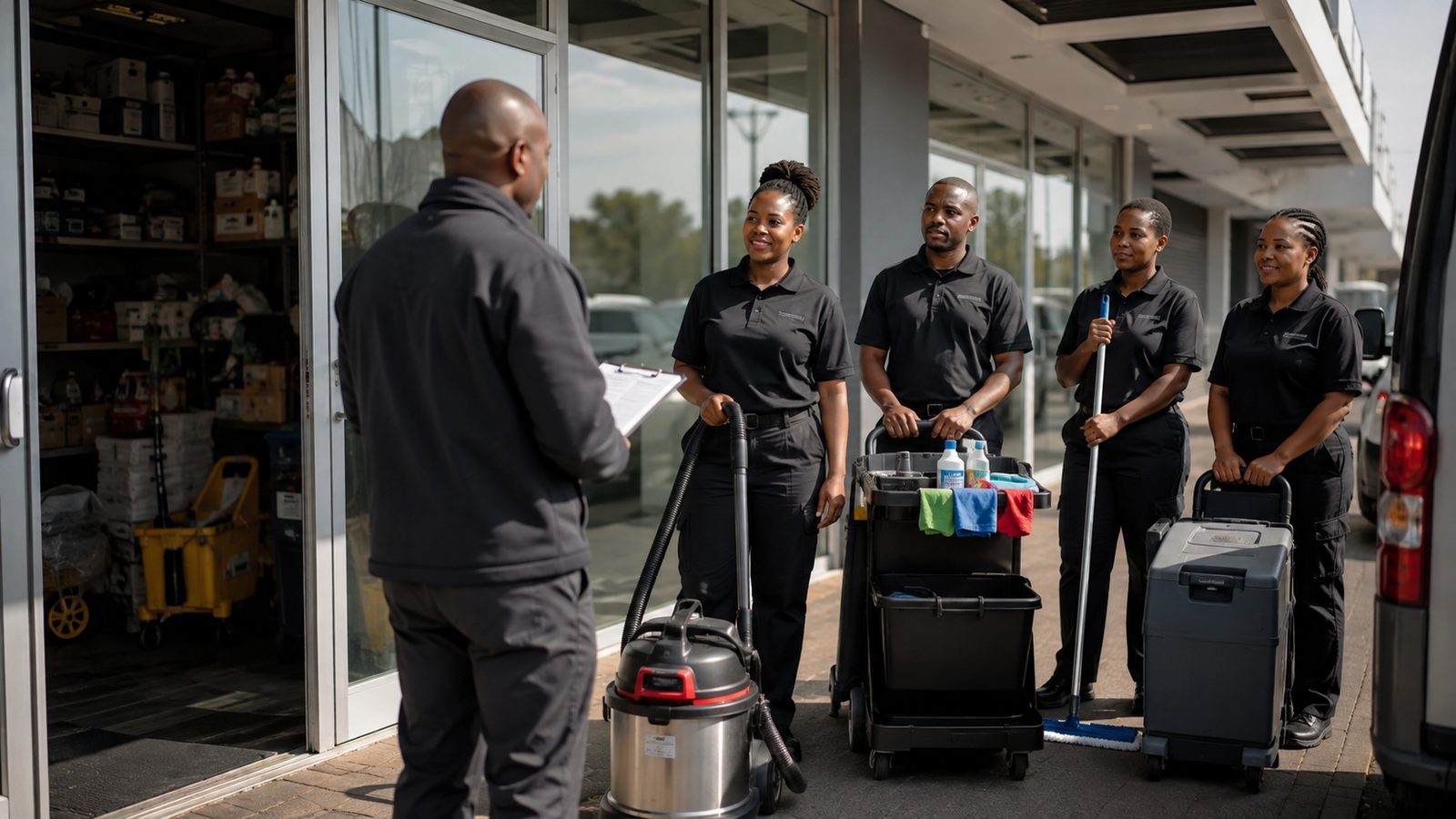
- Trained and supervised staff, with cover arranged by someone else
- Commercial-grade equipment and chemistry, correctly diluted
- Compliance documentation provided rather than maintained by you
- A single point of accountability when the standard slips
- Flexibility to scale the scope up or down without a hiring or retrenchment process
The Return Beyond the Line Item
Two things carry most of the financial return and neither is a cleaning outcome. The first is asset life: carpets, hard floors and furnishings last materially longer when the correct method is used, and flooring is expensive. The second is management time, which is the cost nobody bills but everybody pays.
How to Evaluate a Provider
- Experience with your type of facility, not just cleaning in general
- Compliance position, evidenced rather than asserted
- Staff training and the supervision model — who attends, how often
- Equipment and chemistry appropriate to your surfaces
- A written service level agreement
- Insurance, with the limit visible
What the Agreement Should Define
- Tasks and frequencies by area
- Performance standards and how they are measured
- Response time for a logged complaint
- Which consumables are included
- Reporting and documentation provided
- A scheduled review meeting
The Bottom Line
Compare like with like. Put every in-house cost on the page — wage, statutory contributions, leave, equipment, consumables, supervision time, cover, compliance — and then compare that total against an outsourced commercial cleaning contract. Sometimes in-house still wins, and when it does, that is the right answer.
Frequently Asked Questions
Is outsourcing always more expensive than hiring a cleaner?
Not usually, once the full in-house cost is counted — equipment, consumables, leave and public holiday cover, supervision time and compliance administration. On very small or very simple sites, in-house can still be the cheaper and simpler option.
Can we outsource only part of the work?
Yes, and many businesses do. Keeping day-to-day cleaning in-house while outsourcing periodic work such as carpet extraction, window cleaning, floor sealing or sanitary bin services is a common and sensible arrangement.
What happens if we are unhappy with the service?
That is what the service level agreement is for. It should state the performance standard, the response time for a logged defect, the escalation path, and what happens after repeated failures. If a proposed agreement does not contain those, ask for them before signing.
Want to see the comparison for your site?
We will scope the work honestly, including telling you where keeping it in-house makes sense.
Request a Comparison Or call 079 096 3267