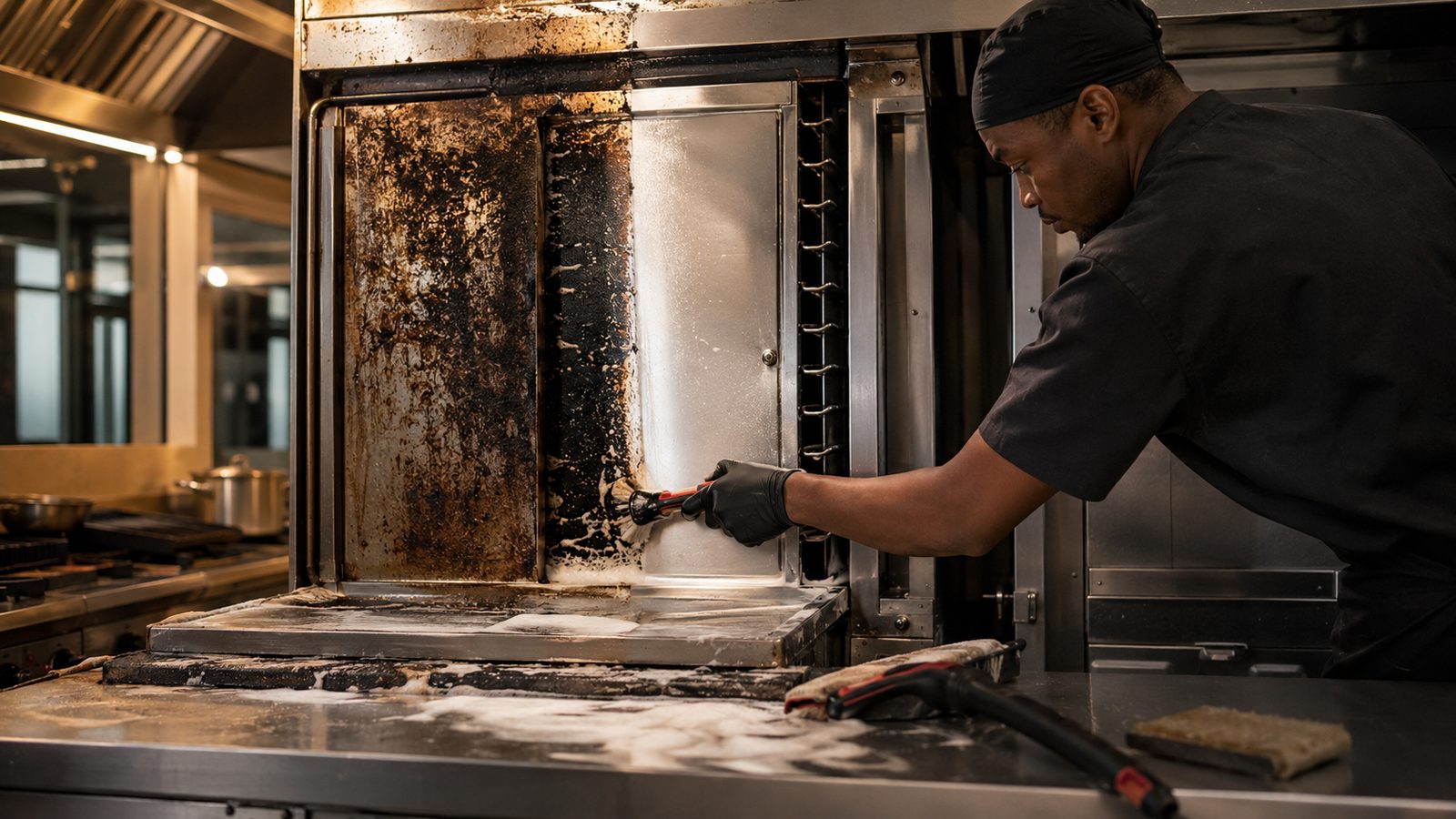
The most dangerous contamination in a commercial kitchen is not on the stove. It is inside the canopy, the ductwork and the extractor fan.
If you run a restaurant, hotel kitchen, lodge or institutional catering operation in Gqeberha, your daily routine almost certainly covers the visible surfaces — counters, floors, cooking equipment. What it usually does not cover is the system pulling grease-laden air out of the room. If your cleaning contract does not address that system explicitly, you are carrying a risk that no one has priced.
How the Problem Builds
Cooking puts airborne grease, vapour and particulate into the air. The extraction system is designed to remove it, which means the grease ends up deposited on the interior surfaces of canopies, filters and ducting. This happens over weeks rather than months in a busy kitchen.
That deposit is not a hygiene nuisance. It is combustible material sitting inside a duct that runs through the building, and a fire that starts in it travels along the ducting rather than staying in the kitchen. It is also a harbourage point for bacteria and pests, which is the health inspector’s interest rather than the fire officer’s.
What we do here, and what we do not
Feathers Cleaning and Hygiene does not clean extraction systems. Canopy interiors, ductwork, fan and motor housings, and any associated work at height are specialist trades requiring equipment and certification we do not hold, and we are not going to pretend otherwise to win a contract. What we do is the back-of-house cleaning around that system and the scope document that makes sure the specialist work is named, scheduled and not quietly forgotten. The rest of this guide is written so you can appoint the right specialist and know what to ask them.
The Regulatory Picture
A commercial kitchen in South Africa sits under several overlapping requirements at once. In broad terms:
- The Occupational Health and Safety Act places the duty to provide a safe working environment on the employer. That duty does not transfer to the cleaning contractor because you appointed one.
- Municipal health bylaws apply to food premises across the Nelson Mandela Bay metro. Environmental health practitioners can and do inspect extraction systems, and a failed inspection can stop trade.
- National Building Regulations and the associated fire safety standards establish the fire-risk context and require extraction installations to be accessible for cleaning. Ducting installed without access panels is a problem before anyone even looks inside it.
- Food-premises hygiene regulations impose specific requirements on surfaces, equipment, waste handling and pest control.
Read this before quoting the law at anyone
We are naming frameworks, not clause numbers. Standard references, regulation numbers and the exact requirements applying to a given premises change over time and differ by use class and by municipality. Confirm the current position for your specific site with the Nelson Mandela Bay environmental health department, your fire consultant and your insurer. We can tell you with confidence what grease does inside a duct and what removes it. We are not the correct source for the legal citation you put in an audit file.
What Deep Cleaning Actually Means Here
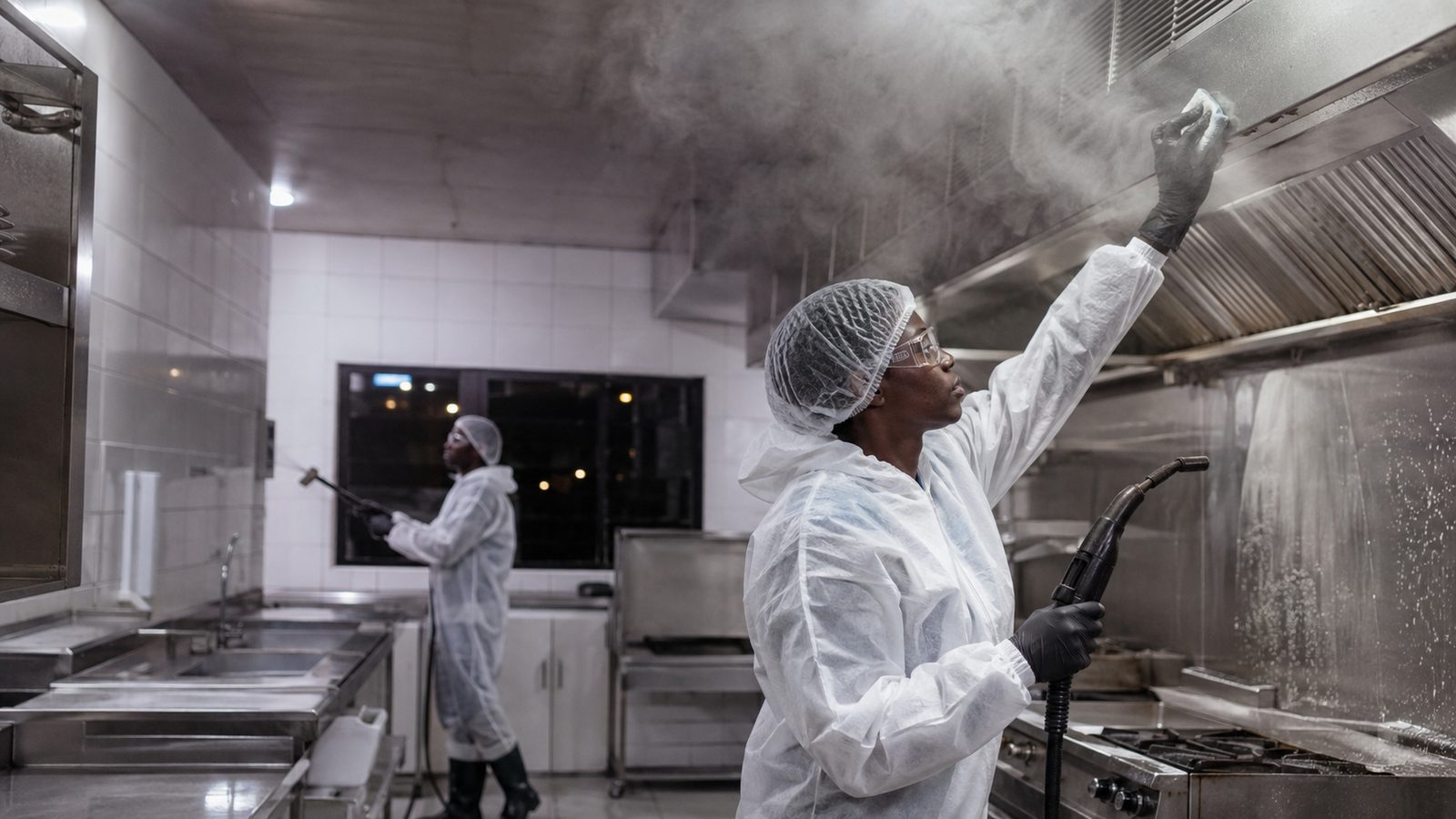
Daily cleaning addresses surfaces. Deep cleaning addresses systems. The difference is worth spelling out in the scope.
Canopy and filters
- Baffle filters removed and immersion-cleaned in a degreasing solution, not wiped in place
- Canopy interior surfaces cleaned, not just the visible stainless exterior
- Light fittings and seals inspected for grease penetration
Ductwork
- Mechanical or chemical removal of deposits from horizontal and vertical runs
- Dated photographic evidence of interior condition before and after
- Access panels resealed and their integrity checked
Extractor fan and motor housing
- Blade cleaning and a balance check
- Motor housing degreased
- Belt and bearing condition noted
Secondary surfaces
- Wall and floor areas behind fixed equipment
- Under and behind refrigeration units
- Grout and silicone where grease has degraded the joint
How Often
There is no single correct interval, and anyone who gives you one without seeing the kitchen is guessing. The workable approach is to tier the frequency by cooking volume and cooking type:
| Cooking profile | Typical deep clean interval |
|---|---|
| Heavy — extended hours, char grilling, wok cooking, deep frying at volume | Shortest cycle; quarterly is common |
| Moderate — full-service restaurant or hotel kitchen | Around twice a year |
| Light — cafe, deli, breakfast service | Annually, with filters cleaned far more often |
Treat that as a starting point for discussion rather than a rule. The deciding evidence is what comes out of the ducting on the first clean. Filters, separately, need attention on a much shorter cycle than the ducting does — in a busy kitchen that is weekly or better.
Confirm the interval with the party who actually carries the risk
Your insurer and your fire consultant are the two people whose opinion on frequency matters most, because they are the ones who will assess a claim or sign off a fire strategy. Ask them directly what interval and what evidence they expect, then write that into the cleaning scope. It is a short conversation and it removes the argument entirely.
The Documentation Is the Point
Most commercial property policies contain maintenance obligations. If a fire starts in a grease-laden extraction system and there is no record of professional deep cleaning, the discussion with the assessor becomes difficult. “We wiped the canopy every night” is not a maintenance record.
What is defensible is a dated report per clean: scope of what was done, photographs of duct interiors before and after, the products used, and who performed the work. Keep them together and keep them for as long as your policy period requires.
What to Require From a Contractor
- Competence and equipment for work at height where ducting is above reach
- Documented training in handling caustic degreasers, and the safety data sheets to match
- A compliant route for disposing of grease waste and chemical effluent
- Photographic reporting as standard, not on request
- Specialised equipment — rotary duct brushes, steam or foam application — rather than general cleaning kit
A contractor who arrives for kitchen deep cleaning with a mop and a spray bottle is not equipped for the work, whatever the quote says.
The Bottom Line
Kitchen deep cleaning is not about making stainless steel shine. It is about removing combustible material from a ventilation system, closing off harbourage points, and building the evidence trail that keeps you insurable and trading.
If your current scope does not name the canopy, the ducting and the extractor with defined frequencies, you do not have a kitchen cleaning contract. You have a surface-wiping arrangement.
Frequently Asked Questions
Is filter cleaning the same as a deep clean?
No. Filters are the accessible part of the system and need frequent attention, often weekly in a busy kitchen. A deep clean addresses what sits behind them — the canopy interior, the ducting and the fan — which frequent filter cleaning does not reach.
Does Feathers clean kitchen extraction systems?
No. Extraction system cleaning is a specialist trade and we do not hold the equipment or certification for it. We cover the back-of-house cleaning around the system, and we will write the scope so the specialist work is named and scheduled rather than left to nobody.
How long does an extraction deep clean take?
It depends on the size of the installation, the length of the duct run and how long it has been since the last one. Most are scheduled overnight or on a closed day so the kitchen loses no service time. Your specialist contractor should confirm the window after assessing the installation.
Need the extraction items properly specified?
We write kitchen cleaning scopes that state plainly what we cover and what needs a specialist extraction contractor.
Request a Kitchen Scope Or call 079 096 3267